
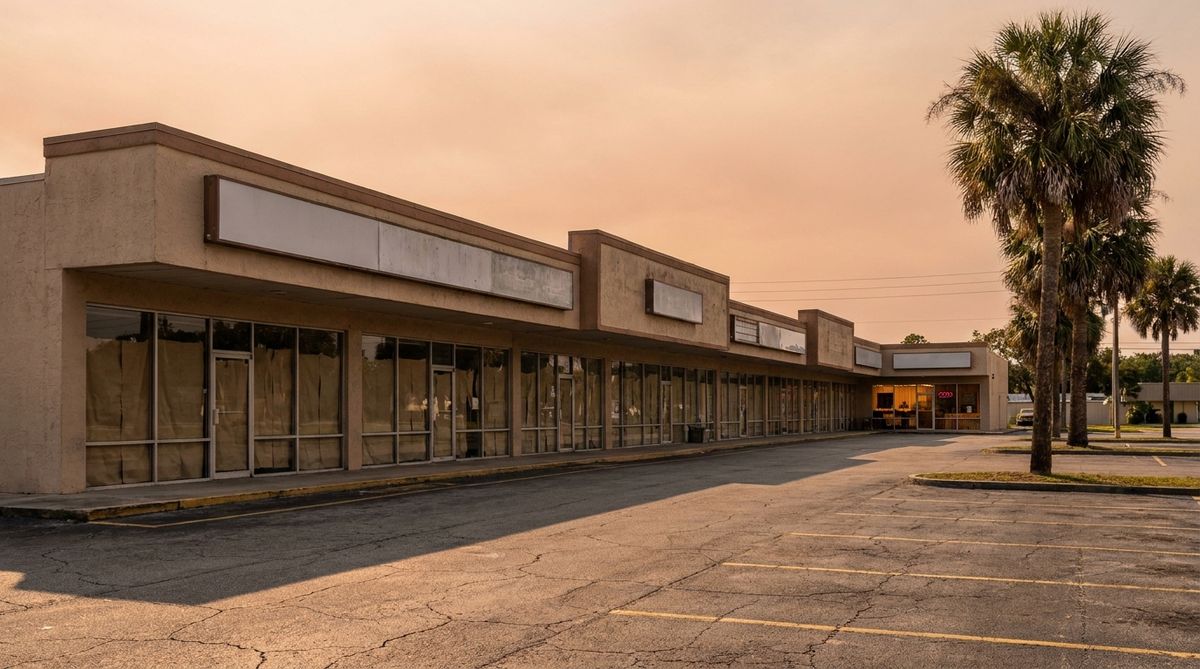
A Florida plaza owner can lose theft, vandalism and water damage coverage on the whole building without a cancellation notice, a premium change or a single letter from the carrier. It happens on the sixty first day after the building drops below 31 percent in use. The declarations page still shows the full building limit, and nothing on the front of the policy says anything changed.
That is the vacancy condition in the standard commercial property form, and on the Gulf Coast it gets triggered by ordinary leasing events: an anchor that consolidates, two inline tenants that leave the same quarter, a center emptied on purpose for a redevelopment. Most owners treat those as leasing problems. They are insurance problems first, and the moves that fix them have to happen before the loss, not after.
What the form actually says
Almost every commercial building in Florida is insured on the ISO Building and Personal Property Coverage Form, CP 00 10, or a carrier form built from it. The current edition is CP 00 10 10 12. Its vacancy loss condition, as quoted in full by IRMI, does two things once the building has been vacant for more than 60 consecutive days before the loss:
- It pays nothing for vandalism, sprinkler leakage (unless the system was protected against freezing), building glass breakage, water damage, theft or attempted theft.
- It reduces payment for every other covered cause of loss by 15 percent.
That second piece is the one owners miss. On a $250,000 wind loss, a 15 percent cut is $37,500, taken before the named storm deductible. It is not a deductible you chose. It is a condition you tripped.
The 31 percent test
Vacant does not mean empty. When the policy is issued to the owner or general lessee, the form says the building is vacant unless at least 31 percent of its total square footage is rented to a tenant and used by that tenant to conduct its customary operations, or used by the owner for its own customary operations.
Three things in that sentence do the real work:
1. Total square footage. Common areas count in the denominator. The rent roll in dollars does not matter. 2. Used, not leased. A tenant still paying rent on a dark unit while it looks for a subtenant is not conducting customary operations there. That space counts as empty. 3. The clock runs on the building, not the lease. The 60 days start when the building falls under the line, which is usually the day a tenant moves out, not the day its lease ends on paper.
Here is how fast it moves. Take a 30,000 square foot plaza. To stay out of the condition it needs at least 9,300 square feet in use. Lose a 12,000 foot grocery and a 6,000 foot gym in the same year and the center can be under the line even though six small tenants are open and paying.
A real renewal: the vacancy permit and the conditions that came with it
I placed the 2026 renewal for an owner whose policy covers only vacant units in two Sarasota buildings. The occupied third building is not on it at all. This is a surplus lines package, and vacancy is the whole point of the account, so it carries a vacancy permit for the full policy term. That permit is what keeps the coverage from collapsing on day 61.
Three things from that renewal are worth knowing for any owner with dark space:
- The underwriter asked twice. Before quoting, the underwriter asked in two separate rounds whether the space was leased or still vacant, and one of the conditions to bind was written confirmation that the quoted units were vacant. Carriers price vacant and occupied space differently, and they check.
- The price went down and the conditions went up. Total cost went from $2,238.41 to $1,960.65. But reading the issued policy, I found a new central station burglar alarm warranty on one building that the prior policy did not have, and the prior application said there was no alarm. If the alarm is not in service, theft is excluded. There is also a sprinkler warranty on both locations. Wind is excluded on this account. Those warranties are policy conditions, not suggestions.
- The schedule lagged the leasing. The binder and the issued policy still listed units that had been leased since the application. It did not open a gap on this policy, but the schedule was wrong, and a wrong schedule is the first thing an adjuster pulls.
That is what vacancy looks like in practice. Not a dramatic exclusion. A series of quiet conditions that only matter on the day of a loss.
The leasing moves that are really insurance moves
When I managed shopping centers, the leasing calendar and the insurance file lived in different drawers. They should be the same file.
Measure the number the month a big lease ends. Pull the site plan, add the square footage actually in use, divide by the total, and email the percentage to your agent. If you are anywhere near 31 percent, that email starts the clock on your side instead of the carrier's.
Get the endorsement before day 60. ISO's Vacancy Permit, CP 04 50, suspends the vacancy condition for the permit period shown on the schedule, per the Insurance Xdate summary of the form. The insurer can still keep vandalism or sprinkler leakage carved out during the permit, so read what came back. Vacancy Changes, CP 04 60, lowers the 31 percent threshold for a center leasing back up from a low base.
Match the permit dates to the leasing plan. A permit is a window. If the lease up takes nine months and the permit runs six, the last three are exposed. Extend before it lapses, not after.
Do not count on the renovation exception without paper. The form says buildings under construction or renovation are not considered vacant. IRMI points out that neither word is defined and that court decisions have gone both ways. A pulled permit, a signed contract and a crew on site are evidence. An owner's intention to renovate someday is not.
Tell the carrier when space fills, too. Leasing back up changes the risk in your favor, but only if the schedule says so. Send the updated rent roll at every leasing change, not just at renewal.
Walk the dark space like an underwriter. Water on to a restroom nobody checks, a roof hatch, the rear door hardware, the alarm panel. Those are the six causes of loss the condition removes, and they are exactly what happens to empty units.
For the full breakdown of the forms and who still writes vacant buildings in Florida, see our vacant commercial building insurance page. The landlord's side of the policy lives on lessor's risk insurance in Florida, and the retail underwriting picture is on the strip center insurance guide.
If your center is losing a tenant this year, send me the site plan and the current policy. I will run the square footage and tell you whether you need a permit and when.
This is general information, not legal advice or a quote. Coverage depends on the actual policy form, its endorsements and underwriting.
The point
The vacancy condition does not care how a center feels. It counts square feet in use, starts a 60 day clock, and then strips the coverage empty buildings need most. Measure the number when the lease ends and get the permit in writing before day 60.
Sources
- Catherine L. Trischan, Vacancy: What Does It Mean for Commercial Property Coverage?, IRMI, January 30, 2026 (quotes the ISO CP 00 10 10 12 vacancy loss condition in full, including the 60 day, 15 percent, 31 percent and construction or renovation language).
- ISO form CP 00 10, Building and Personal Property Coverage Form, Insurance Xdate form summary, edition 10 12.
- ISO form CP 04 50, Vacancy Permit, Insurance Xdate form summary, edition 07 88.
- ISO form CP 04 60, Vacancy Changes, Insurance Xdate form summary.
- Renewal facts: Hendrickson Insurance client file, 2026 to 2027 surplus lines package renewal, Sarasota, anonymized.
Get a quote on this coverage.
Ten minutes on the application. Dennis reads it himself and responds the same business day in most cases.
Start the application →Hendrickson Insurance, (941) 957-2796, dennis@hendricksonins.com, FL License E095547.
Coverage descriptions are general. Actual coverage is governed by the terms, conditions, and exclusions of the issued policy. Availability varies by carrier and by state.
