
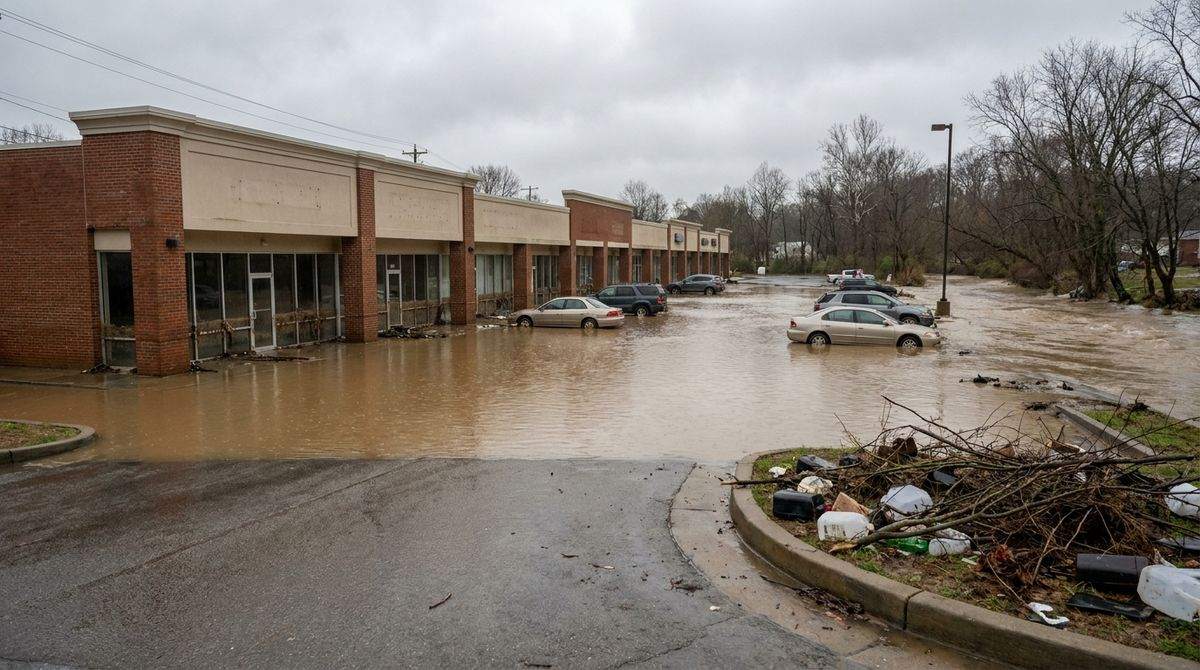
Hurricane Helene came ashore in the Florida Big Bend as a Category 4 on September 26, 2024. The worst of what it did happened two days later and hundreds of miles inland. The National Hurricane Center's final report records 30.78 inches of rain at Busick, North Carolina, the Swannanoa River at Biltmore cresting at 27.33 feet against a 1916 record of 20.7, and Asheville's River Arts District "largely destroyed." In Biltmore Village, lower-lying buildings were "severely inundated with deep water or swept away."
Those were businesses on the water, in buildings with property policies. The policies were not the problem. Almost every commercial property form excludes flood. NC Newsline, using FEMA data, estimated that about 10.2 percent of commercial properties in the affected region carried federal flood insurance. The other nine in ten found out the hard way that their building coverage stops where the water starts.
The test most plaza owners use
Ask a plaza owner whether they need flood insurance and you usually get one of two answers. "The bank didn't require it," or "we're not in a flood zone."
Both answers come from the same place. The Flood Disaster Protection Act of 1973 requires flood insurance on a federally backed or regulated loan only when the building sits in a Special Flood Hazard Area, the 1 percent annual chance zone on the FEMA map. Outside that line, federal law requires nothing. A lender can ask for more, but the federal rule only sets the floor, and the floor is drawn by the map.
The map is the weak link. In The Washington Post's October 2024 analysis of FEMA policy data, Jeremy Porter of the First Street Foundation pointed out that the federal maps do not include flooding from small waterways like creeks and streams, and do not treat heavy rainfall as a flood source. Helene was exactly that kind of flood. Rain on saturated ground, every creek in the county rising at once, and water in buildings no map had ever flagged.
The same Post analysis found that fewer than 1 percent of households in Buncombe County had flood insurance, and that across the inland counties Helene hit in seven states only 0.8 percent of homes were covered, against 21 percent in coastal counties. Commercial coverage was better, and it was still one in ten.
Why this is not just a mountain problem
It is easy to read Helene as an Asheville story. It is not. The NHC report notes that the first flash flood emergency of the storm was issued on the evening of September 26 for a dam release in the Charlotte area, before the core of the storm even reached the western Carolinas.
Every metro in the Carolinas and on the Florida Gulf Coast has the same setup: older neighborhood centers built in the 1970s and 1980s along the commercial corridors, many backed up to a creek, a drainage canal or a retention pond. The parking lot is the low point. The rear service drive is lower. The map may show the building in a moderate risk zone, or shaded X, and the lender's flood certificate comes back clean.
And then a storm stalls. Florida is all flood zone, hazardous or non-hazardous. The Carolinas proved in 2024 that the inland Piedmont and the mountains are too.
What the policy actually looks like
For a plaza that wants the coverage, the base is the National Flood Insurance Program. The FEMA commercial summary of coverage lists the limits for a non-residential building: building property up to 500,000 dollars and personal property up to 500,000 dollars, written and deducted separately.
Three things about that policy matter for a shopping center owner.
The building cap is per building, and it is small. A neighborhood center's rebuild cost is usually far above that. 500,000 dollars of flood coverage on that building is a start, not a recovery. The answer is excess flood above the NFIP, from a private carrier or Lloyd's, sitting on top. Private flood belongs there, as excess. I keep the NFIP as the primary layer because it is backed by the federal government and does not walk away from a building after it pays a claim.
The NFIP does not pay lost rents. The FEMA summary lists financial losses from business interruption or loss of use among the things it does not cover. When the water closes the center, tenants with a casualty abatement clause stop paying. For a landlord, lost rent is often the bigger number. Rental value for flood has to come from somewhere else, usually an excess flood form that includes it. That is a line to ask for by name.
You cannot buy it when the storm has a name. FEMA states there is typically a 30-day waiting period before a new NFIP policy takes effect, with exceptions tied to a loan closing or a map change. Helene's track was on the news for days before the rain. Owners who called that week were too late.
What a plaza owner on a creek should do now
1. Pull the flood zone and the elevation, not just the zone letter. The FEMA Flood Map Service Center shows the zone. An elevation certificate shows how far the first floor sits above the base flood elevation. Both go in the submission. 2. Walk the back of the building. Where does water go when the lot floods? Is the creek, canal or pond within a few hundred feet? Are the HVAC units, electrical panels and tenant stock at grade? That walk is underwriting information whether the map agrees or not. 3. Price the NFIP even if no one requires it. A quote costs nothing, and the number belongs next to the cost of the creek coming in. 4. Put excess flood and rental value on the same conversation. Know what the building costs to rebuild, subtract the NFIP limit, and decide whether to carry the gap. Ask for rental value to be included in the excess. 5. Read every tenant lease for the abatement clause. If the rent stops when the space is untenantable, the rental value limit needs to cover the real rebuild time, not a guess.
The point
Helene put the most destructive water in decades into inland towns where nine in ten commercial buildings had no flood policy, and most of those owners were following the only rule they were given: the lender's map. The map tells you what federal law requires, not where water goes. A plaza on a creek needs NFIP underneath, excess and rental value on top, and all of it bought before the forecast.
Sources
- National Hurricane Center, Tropical Cyclone Report: Hurricane Helene (AL092024), 2025, covering September 2024.
- NC Newsline, Few were insured against Helene's floods. Those that were faced delays, frustrating hurdles, April 22, 2025, FEMA data for 2024.
- The Washington Post via Anchorage Daily News, Nearly all homes in counties hardest hit by Helene lack national flood insurance, October 3, 2024, FEMA policy counts as of October 1, 2024.
- FEMA, NFIP Summary of Coverage: Commercial Property, January 2024 edition.
- FEMA, Flood Insurance, waiting period, current.
- FEMA, Flood Insurance terminology index: Mandatory Purchase, Flood Disaster Protection Act of 1973.
- FEMA, Flood Map Service Center.
Get a quote on this coverage.
Ten minutes on the application. Dennis reads it himself and responds the same business day in most cases.
Start the application →Hendrickson Insurance, (941) 957-2796, dennis@hendricksonins.com, FL License E095547.
Coverage descriptions are general. Actual coverage is governed by the terms, conditions, and exclusions of the issued policy. Availability varies by carrier and by state.
