
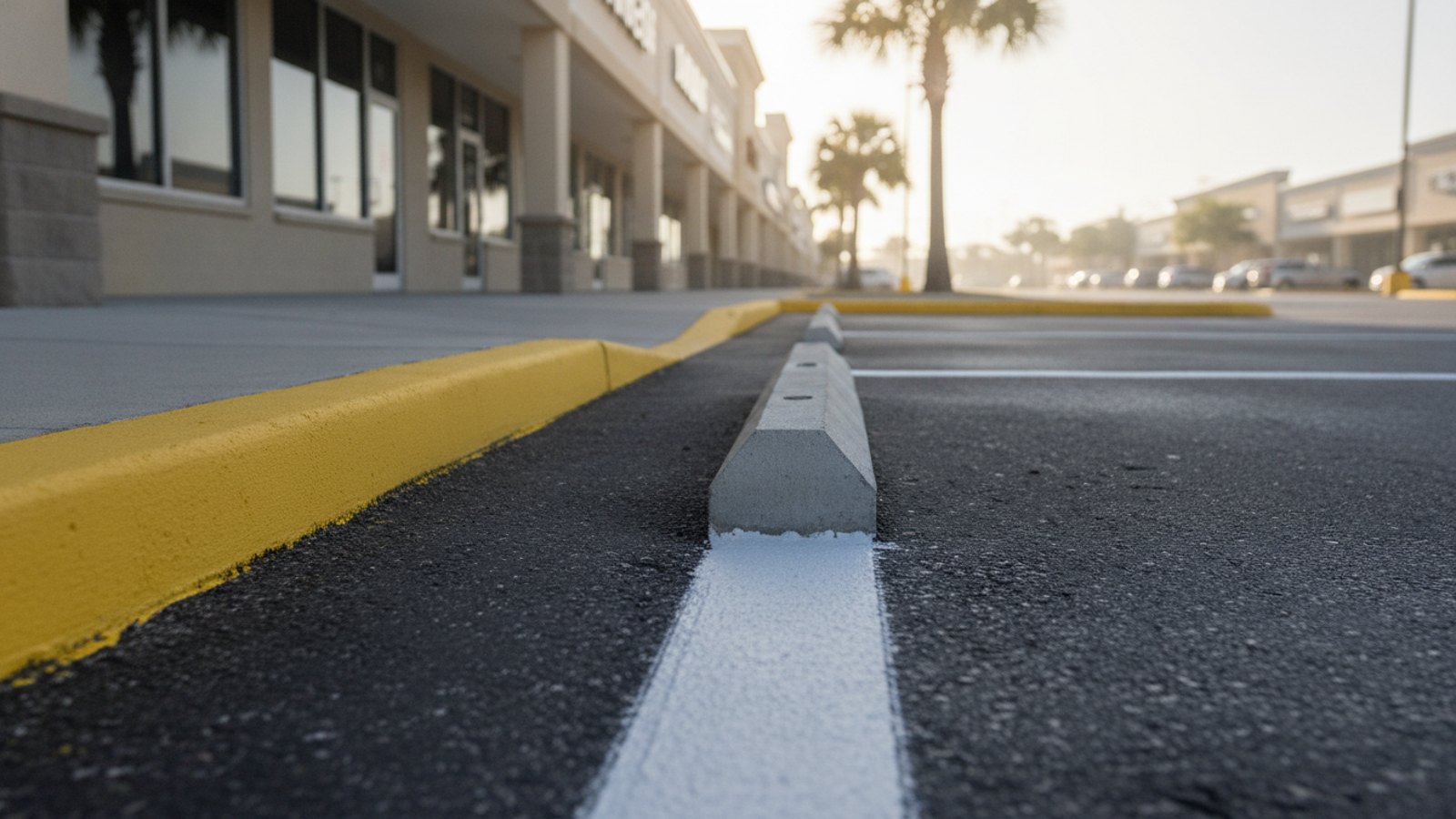
Every couple of years a strip center needs its parking lot sealcoated and restriped. It is routine maintenance, the kind of line item that gets scheduled and half forgotten. But when we scope that job, it always includes two things beyond fresh black asphalt and crisp white lines: repainting every curb yellow, and remarking every wheel stop so it sits centered and visible on its stripe. In Florida, for a strip center owner carrying commercial property and general liability insurance, that detail is not cosmetic. It is a documented answer to a trip-and-fall claim before the claim ever happens.
The Wheel Stop Nobody Thinks About Until Someone Trips On It
Wheel stops, also called parking bumpers or parking stops, sit at the front of a parking space to keep a car from rolling into a sidewalk, a storefront, or a walkway. They do their job quietly for years. Then the paint fades, a stop shifts a few inches after a delivery truck clips it, or a stripe simply does not get repainted at the same time as the rest of the lot, and the stop becomes something a customer does not see until they are already falling. Whether the stop was really at fault does not matter much once someone is on the ground. It becomes a claim, and in Florida, a wheel stop claim is not automatically thrown out.
The Case That Changed the Calculus: Parker v. Shelmar
On June 21, 2019, Florida's Fifth District Court of Appeal decided Parker v. Shelmar Property Owner's Association, Inc., Case No. 5D18-2105, reported at 274 So. 3d 1219. A woman tripped on a wheel stop in the association's parking lot. The association moved for summary judgment, arguing the wheel stop was open and obvious and invitees should be expected to see it and protect themselves. The trial court agreed and dismissed the case. The Fifth DCA reversed.
The difference came down to placement. Parker filed an affidavit from a forensic engineer who said the wheel stop sat in the pathway into the building and that its location violated Florida Building Code Chapter 10, Section 1002.1, along with an industry safe-walking-surfaces standard. The court restated that evidence of a building code violation is prima facie evidence of negligence, which is a fact a jury gets to weigh, not something a judge can dismiss at summary judgment, and it sent the case back.
"A documented building code violation is prima facie evidence of negligence. That is not automatic liability. It is a fact a jury gets to hear."
In a footnote the court distinguished an earlier case, Ramsey v. Home Depot. There the defendant's expert found no code violations and the plaintiff's expert offered only a conclusory opinion without pointing to a specific code provision or guideline, and the claim did not survive summary judgment. Same basic fact pattern, tripping over a wheel stop, opposite outcomes. What separated them was whether the plaintiff could point to a specific code provision and a placement that violated it.
Why "Open and Obvious" Does Not Automatically Protect You
Florida's open and obvious danger doctrine says that if a hazard would be apparent to a reasonable person, the property owner may not have a duty to warn about it. It was Shelmar's entire defense in Parker, and it is the instinct a lot of owners have: the bumper was right there, anyone should have seen it, case closed. But the doctrine does not eliminate the underlying duty to keep the premises in a reasonably safe condition, particularly along paths people cannot avoid: entries, walkways, the last few feet between a parking space and a storefront door. Once the placement violates a building code section written specifically to keep those paths clear of obstructions, open and obvious stops being a complete defense and becomes one more fact question for the jury.
What a Proper Restriping Job Actually Buys You
This is where the maintenance schedule matters more than most owners realize. When we restripe a lot, we are not just making it look sharp for a new tenant walkthrough. We are confirming every wheel stop is centered on its stripe, that none has drifted into a walkway or an egress path, and that curbs along walking surfaces are painted yellow and visible, day or night. That last point matters more than it sounds. A wheel stop that is hard to see because the lot is poorly lit at night is a weaker case for the owner for the same underlying reason a faded, off-stripe stop is: it is evidence the condition was foreseeable and something reasonable maintenance would have caught.
- Confirm every wheel stop is centered within its painted stripe, not drifted or missing entirely
- Repaint curbs yellow along every pedestrian path, not just the ones visible from the road
- Check placement against the approved site plan, not just against how the lot looked last time
- Keep the paving contractor's invoice and scope of work on file with a date, it is documentation the condition was addressed
- Walk the lot after every repaving job before signing off, in daylight and again after dark
The Insurance Side of a Faded Stripe
From an underwriting standpoint, a documented maintenance history on paving, striping, and curb marking is the same kind of record retail owners should keep for roof inspections and fire sprinkler tests. If a trip-and-fall claim comes in and the wheel stop was centered, visible, and matched the approved layout, that is a very different conversation with an adjuster than a claim where the stop had drifted eight inches into the walkway two repaving cycles ago and nobody caught it. Dated invoices and photos from the last restriping job are cheap insurance against a claim that would otherwise turn into exactly the kind of fact question the Fifth DCA sent back to a jury in Parker.
Poor lot lighting creates the same fact pattern after dark, on top of whatever the stripe and stop look like at noon.
Poor lot lighting compounds this exact risk after dark. See parking lot lighting and negligent security in Florida strip centers. Owners who want the full coverage picture can start with the Florida strip mall insurance guide.
Sources
Case summaries are plain-language readings of the published opinions, not legal advice. Ask a Florida attorney how a case applies to a specific property.
