
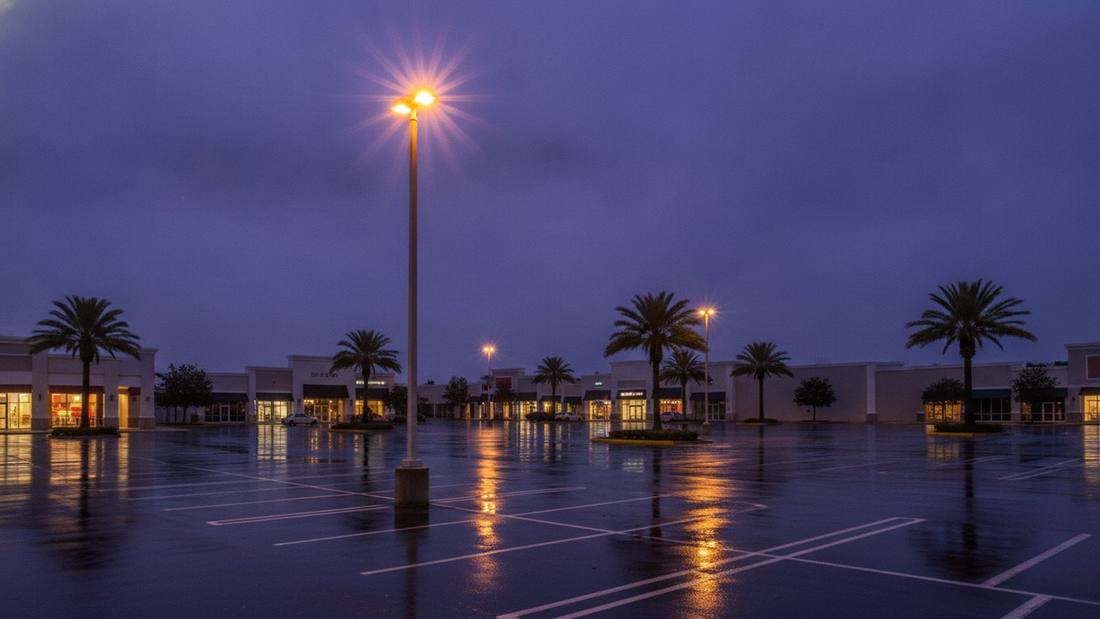
A strip center's parking lot lighting does not get much attention until something happens under it. As a property manager on the Gulf Coast, I had a lighting maintenance company on contract for every property, checking every fixture on a set schedule, replacing bulbs before tenants noticed they were out, and evaluating LED upgrades as fixtures aged, not waiting for a complaint to trigger a truck roll. For a Florida strip center owner, that habit does more than keep the lot looking sharp. It is one of the more effective things you can do to protect the property's general liability insurance position going into a renewal. The strip center insurance in Florida guide shows where lot lighting sits in the full program.
Two Different Claims Live in the Same Dark Parking Lot
Poor lighting creates two distinct exposures, and owners tend to think about only one of them. The first is the obvious one: a trip-and-fall. Someone catches a curb, a wheel stop, or a pothole they could not see in a poorly lit corner of the lot. The second is less obvious and often more expensive: negligent security. If someone is assaulted or robbed in your parking lot at night and alleges the lot was dark enough that a reasonable person could not see danger coming, or that the darkness itself is what invited the crime, that becomes a negligent security claim against the property, not just against whoever committed the crime.
Florida Negligent Security Law Turns on Foreseeability
Florida courts do not hold a property owner responsible for every crime that happens on their property. The question is whether the crime was foreseeable, meaning whether a reasonable owner should have anticipated it based on what they knew or should have known. A leading case is Holiday Inns, Inc. v. Shelburne, 576 So. 2d 322, decided by Florida's Fourth District Court of Appeal in 1991. A fight at the bar inside a Fort Pierce Holiday Inn ended in a shooting, and the record showed 58 police reports tied to the bar in the previous 18 months. The court refused to limit foreseeability to prior similar acts and held that an owner's knowledge of general disorderly conduct, based on past experience, can establish it. (The Florida Supreme Court later disapproved the case on other grounds, in Angrand v. Key, 1995.) A later Fourth District case, Prime Hospitality Corp. v. Simms (1997), treated foreseeability as a jury question: the hotel had 56 crimes on its premises over about two and a half years, none in the corridor where the guest was attacked, and the jury still found it negligent. Courts look at the circumstances as a whole: the history of similar incidents on or near the property, foot traffic volume, whether the owner had prior notice of vulnerabilities such as broken lights or complaints about dark areas, and the crime patterns of the surrounding area.
"You do not need an identical prior crime on your property for a negligent security claim to survive. Courts look at the whole picture, including whether the owner had notice of a vulnerability and did nothing."
What Actually Moves the Foreseeability Needle
In practice, a few things drive whether a negligent security claim against a strip center gets traction:
- A documented history of crime or complaints on the property or nearby
- Foot traffic and hours of operation, a plaza with a bar or restaurant open past dark carries more exposure than a strip of daytime-only offices
- Whether the owner had prior notice of a vulnerability, a broken light, a dead security camera, a tenant complaint about a dark corner, and did nothing about it
- Local crime data for the surrounding area
That third factor is where a documented maintenance program does real work. If a fixture goes out and gets flagged and replaced within days as part of a routine inspection, there is no unaddressed notice for a plaintiff's attorney to point to. If the same fixture sat dark for months with no record anyone did anything about it, that is close to the exact fact pattern that turns a hard-to-prove negligent security claim into an easy one.
A Scheduled Lighting Program Is the Real Insurance Move
This is the part most owners miss. Reactive lighting maintenance, where a bulb only gets replaced after a tenant calls to complain, creates a paper trail of exactly the kind of prior notice that works against you in a foreseeability argument. A documented, scheduled program does the opposite. Regular fixture checks, replacement records with dates, and periodic evaluation of whether older fixtures should be upgraded to LED for better, more consistent coverage all become evidence that the owner was not sitting on a known dark spot. It will not make a determined plaintiff's attorney go away, but it changes the conversation from the owner knew and ignored it to the owner had a program and this was addressed on schedule. That is a materially different case, and a materially different renewal conversation with your insurer.
The same lighting gaps that create a negligent security exposure also create the trip-and-fall exposure covered in the piece on wheel stops and curb marking. A wheel stop that is correctly centered and placed during the day can still be the reason someone falls at nine at night if the fixture above it has been out for three weeks. Treat lighting and striping as one maintenance conversation, not two separate line items.
What to Do
- Put every fixture on a written, dated inspection schedule, not a complaint-driven one
- Keep replacement and repair records on file, they are your evidence that a vulnerability did not sit unaddressed
- Evaluate LED upgrades as fixtures age instead of only replacing like for like
- Walk the property after dark periodically, not just during the day
- Loop your insurance agent in on the program so it is reflected accurately at renewal
A faded stripe or drifted wheel stop is a related, compounding risk after dark. See wheel stops, curb paint, and trip claims in Florida strip centers. For the full coverage picture, start with the Florida strip mall insurance guide.
Sources
- Holiday Inns, Inc. v. Shelburne, 576 So. 2d 322 (Fla. 4th DCA 1991), 1991
- Prime Hospitality Corp. v. Simms, Nos. 96-2652 and 96-3304 (Fla. 4th DCA Oct. 15, 1997), 1997
Case summaries are plain-language readings of the published opinions, not legal advice. Ask a Florida attorney how a case applies to a specific property.
