
Updated October 13, 2026. Corrections and sources are listed in the update log at the bottom.
Last week a letter came in from one of the billboard law firms. It was on behalf of an elderly woman who fell in a parking lot at one of the properties I work with. The claim was that she went down because the curbs were not properly marked. The letter was confident, the way those letters always are.
Then we pulled the video.
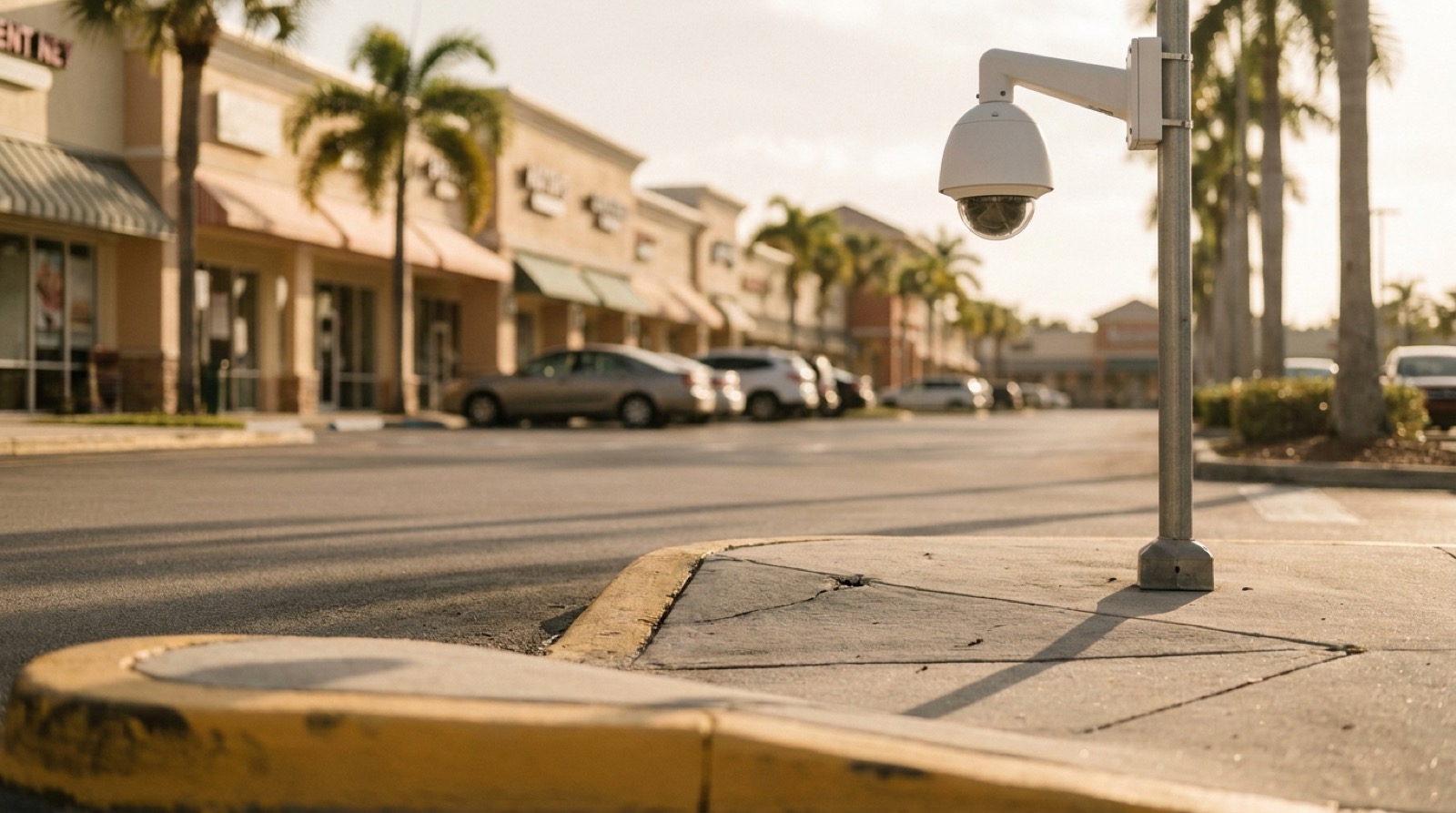
The camera showed her step out of a car, stand her walker up, let go of it, and fall over. Nobody bumped her. No curb was involved. The driver who had brought her was looking the other way and did not see it happen, which is not a crime, but it also means there was no witness to contradict the story once a lawyer got hold of it. The only witness that mattered was mounted on a light pole, and it had been recording the whole time.
The footage went to the carrier. The carrier told the lawyer it was not going to pay, because the video showed the claim in his letter was not what happened. The lawyer looked at the same video and agreed. That was the end of it. No deposition, no mediation, no check.
Now take the camera away. Without that footage it is he said, she said, and this is a claim the property owner very likely pays. Not because he did anything wrong. Because he could not prove he did not. For how the liability side of a plaza policy is built, see the Florida strip mall insurance guide.
How these claims actually go
I have been on the insurance side of premises claims for years, and before that I managed shopping centers. Here is the pattern. Someone falls. Weeks or months later a letter arrives from a firm that advertises on every highway in Florida. The story in the letter has been shaped by then: the curb was unmarked, the lighting was poor, there was a crack, there was water. The claimant may believe it. The lawyer certainly writes it that way. The carrier looks at what it can prove and what a jury in that county tends to do with a sympathetic plaintiff, and it prices the claim accordingly.
If there is no video, it is your word against a signed statement and a medical file. A lot of those cases settle for real money. Some go to trial, and the insured loses more of them than you would think, because a jury is being asked to choose between a hurt person and a property owner, and the property owner has nothing to show them.
Why cameras change the math
A camera does not make you less liable. It makes the truth available. When the truth is that your property was fine and the fall was a fall, the claim dies in the adjuster's inbox instead of in a courtroom two years from now. That is the whole value, and it is enormous.
It cuts the other way too, and you should want that. If the video shows a pothole you knew about or a ramp with no handrail, you have a problem you need to fix, and the sooner you know it the cheaper it is. Either way, the footage ends the argument, and ending the argument is what saves the money.
There is a quieter benefit as well. Underwriters ask about cameras on almost every commercial property and general liability application now. A property with good coverage, retained footage, and an incident procedure is a better risk on paper, and it gets treated like one at renewal.
The setup that actually works
Most centers I walk have a couple of cameras pointed at the front doors and nothing else. That is not a system, it is a decoration. Here is what covers you:
Cover the places people fall. Curbs, ramps, steps, and the transitions between them. Parking lot drive aisles and the walkways from the lot to the doors. Dumpster enclosures and the back of the building. Entrances, inside and out. If you have a sidewalk cafe or an outdoor seating area, cover it.
Enough resolution to see a face and a foot. You need to be able to tell what a person was doing, not just that a shape moved. Modern cameras are cheap enough that there is no excuse for a grainy feed.
Night coverage. A lot of these claims cite lighting. Cameras that record clearly at night both protect you and show whether the lighting was actually adequate.
Retention that survives the delay. This is where owners get burned. Many systems overwrite in seven to fourteen days. The letter from the lawyer shows up in week six. Keep at least ninety days of footage, and the moment anyone reports an incident, pull that clip and save it somewhere permanent.
An incident procedure your manager actually follows. Written report the same day. Names and phone numbers of anyone present. Photos of the exact spot. The video clip exported and sent to your agent. That package is what your carrier's adjuster needs, and it is the difference between a claim that closes and a claim that lingers.
What Florida law did and did not fix
Florida changed its negligence law in 2023. A plaintiff who is found more than half at fault now recovers nothing, and the window to file a negligence suit dropped from four years to two. Those are real improvements for property owners. They do not make claims go away, and they do not help you at all if you cannot show what happened. A comparative fault defense is only as good as your evidence of the plaintiff's fault. The video is that evidence.
Who pays for the ones that get through
Every claim that settles because the owner could not prove the truth gets paid out of the same pool. The Coalition Against Insurance Fraud's 2022 study put the annual cost of insurance fraud in the United States at 308.6 billion dollars across every line of insurance, about 45 billion of it in property and casualty. Premises claims that were never the owner's fault are a slice of that property and casualty number. It comes back to every one of us as premium. When your general liability renewal comes in higher and you did not have a claim, this is a piece of why.
I am not writing this to say every person who falls is lying. People get hurt, and some properties are genuinely unsafe. I am writing it because I have now watched, more than once, a claim that would have cost an owner real money evaporate in an afternoon because a camera was doing its job. I have also watched owners without cameras write checks for things that never happened the way the letter said. I will see it again this year. So will you, if you own property long enough.
The bottom line
If you own a strip center, a plaza, an office building, a restaurant, or any property the public walks across, cameras are not a security expense. They are a liability defense, and they are the cheapest one you will ever buy. Cover the curbs, the ramps, the lot, and the doors. Keep ninety days. Save the clip the day something happens. Send it to your agent.
If you want me to look at how your property is set up against this kind of claim, or at whether your property and liability program is priced like the risk you actually are, call or text 941-957-2796 or start here. I have managed these buildings, and I have sat on the other side of these letters. I know what the footage is worth.
Sources
- Coalition Against Insurance Fraud, The Impact of Insurance Fraud on the U.S. Economy (2022): insurancefraud.org
- Florida HB 837 (2023), tort reform including modified comparative negligence and the two-year negligence limitations period: www.flsenate.gov
- Section 768.81, Florida Statutes, comparative fault (2025): www.flsenate.gov
Update Log
- October 13, 2026: Corrected the fraud-cost sentence: the 308.6 billion dollar Coalition Against Insurance Fraud figure (2022) covers all lines, with about 45 billion in property and casualty. Added sources.
