
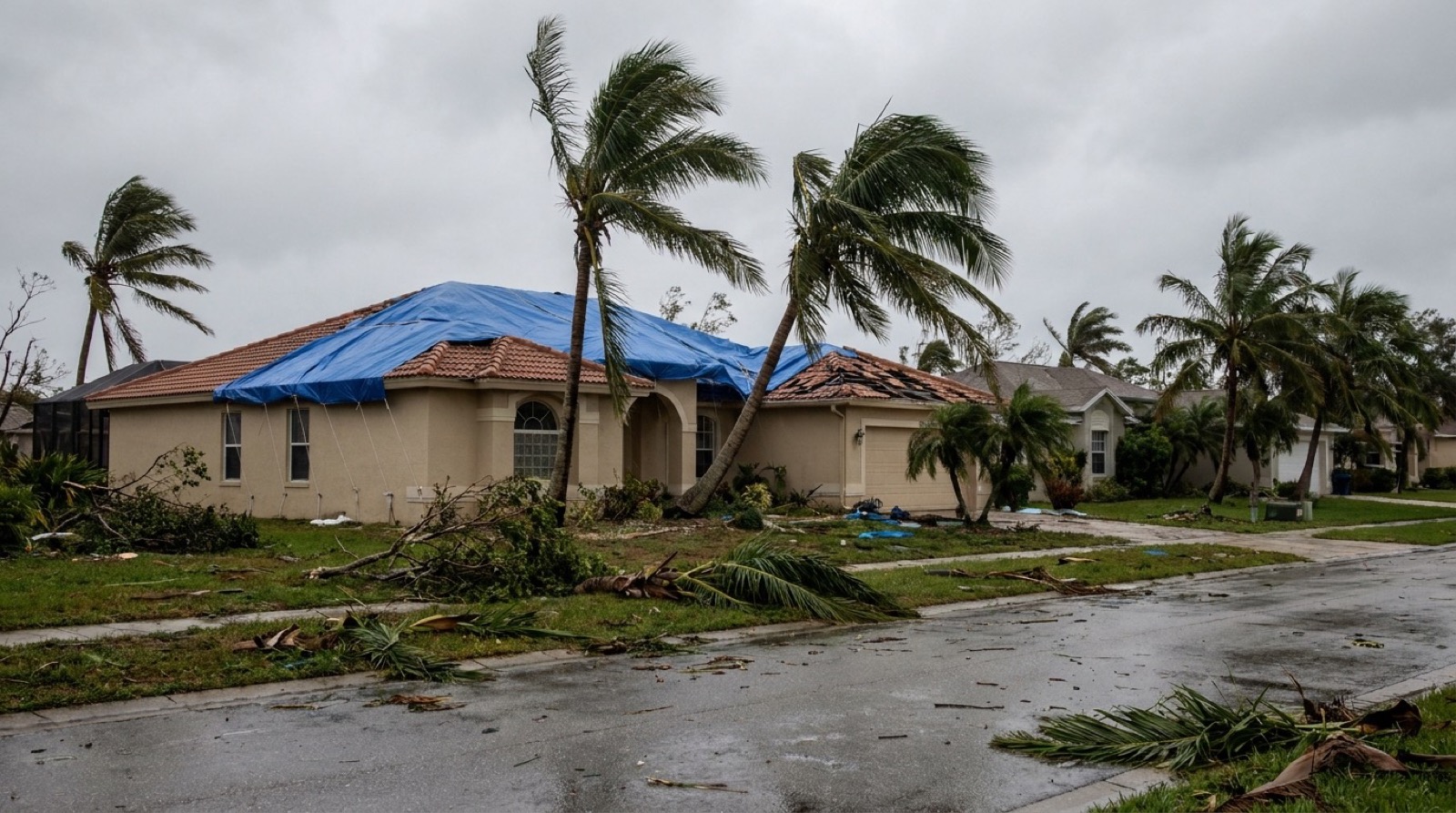
Most people buying homeowners insurance in Florida do the same thing. They collect a few quotes, sort by price, and take the lowest one. Almost nobody reads past the premium. If you want to be in the small group that does, keep reading, because the cheapest quote on a Florida house is very often the smallest policy.
How a quote gets cheap
Here it is with round numbers. I quote a house at $1,000,000 replacement cost on the dwelling. Another agent quotes the same house at $500,000. The other coverages come in lower too: personal property, other structures, loss of use. The lower quote wins the sale, because price is the one number every buyer compares.
The market is competitive, and the fastest way to a lower premium is a lower limit. The owner isn't deciding that the house won't burn or blow down. The owner is taking the agent's word that the quote is right, and has never looked at the replacement cost number. That's the gap.
Then a claim happens.
The 80% rule
People call it a coinsurance penalty. On a homeowners policy the clause is the 80% rule, and it works the same way. The standard homeowners form (ISO form HO 00 03) puts it in the loss settlement condition:
- If your dwelling limit is at least 80% of the full replacement cost of the house right before the loss, the policy pays the cost to repair or replace, up to your limit, after the deductible.
- If your limit is under 80%, the policy pays the greater of two amounts: the actual cash value of the damaged part, or the same proportion of the repair cost that your limit bears to 80% of replacement cost.
Run the round numbers. The house costs $1,000,000 to rebuild, so 80% is $800,000. The cheap policy carries $500,000. That's 62.5% of what the policy requires. A $200,000 repair pays about $125,000. The owner covers the other $75,000, and the deductible comes off on top of that.
That penalty applies to partial losses, which are the most common kind. If the house is a total loss, the policy pays the limit, and the limit is $500,000 on a house that costs $1,000,000 to rebuild.
The other numbers move too
The dwelling limit sets more than the dwelling. The Triple-I homeowners handbook says detached structures are generally about 10% of the dwelling limit, personal property is generally 50% to 70% of it, and additional living expenses are about 20% of it. Those are typical figures and individual policies vary. Cut the dwelling limit in half and the others shrink with it.
On a $1,000,000 dwelling, that's roughly $100,000 for other structures and $200,000 for living expenses if the house can't be lived in. On $500,000 it's half of that. When two quotes look alike, check dwelling, personal property, liability, water damage and screened enclosure. A lower price with lower limits is a different product.
How many people end up short
I couldn't find a Florida-wide number, and nobody I found publishes one. Here is what studies of real claims show. They cover California and Colorado fires, not Florida hurricanes.
- A study of 74,070 California fire claims on owner-occupied homes from 2018 to 2023 found 71.3% of destroyed homes were underinsured, by an average of about 19%. The data excludes flood and wind claims.
- A Federal Reserve Bank of Philadelphia paper on the Marshall Fire in Colorado estimated 74% of policyholders were underinsured and 36% severely underinsured, with limits under three-quarters of rebuild cost. It also found wide gaps between insurers that persisted after adjusting for the household.
- United Policyholders surveyed 675 households after the January 2025 Los Angeles fires. Of those with total losses, 7% said they had enough insurance to rebuild and 69% said they did not.
The Fed paper found something else. Shoppers treat insurers that write less coverage as if they charge lower premiums, and pass up the chance to buy more coverage for the same money. The authors call it coverage neglect. That's what a price-only comparison does, and it's why this keeps happening.
Most of those homeowners didn't pick a low limit on purpose. In the California data, 82% to 99.5% wanted full coverage and believed they had it. Someone who takes a half-size limit to save money is starting well behind them.
How to compare quotes
- Ask each agent for the replacement cost estimate and what it was built from. Get it in writing.
- Ask for the dwelling limit as a percentage of that estimate. Anything under 100% needs a reason.
- Ask whether the policy carries extended replacement cost, and how much.
- Put the five numbers above side by side.
- If a quote is far cheaper, ask what it leaves out before you ask how they did it.
Reading a quote takes about ten minutes. Dealing with the claim after a fire or a hurricane takes months. If you want a second opinion, send me both quotes. I'll tell you which one is the smaller policy and what it would pay on a partial loss. See homeowners insurance, and for the commercial version of this same penalty, the coinsurance trap. Phone (941) 957-2796.
This is general information, not legal advice or a quote. Loss settlement terms differ by policy. Check the wording on yours.
Sources
- ISO Homeowners 3 Special Form HO 00 03, Section I Conditions, Loss Settlement (80% replacement cost provision).
- Stephen Owens, Insurers' own rebuild estimates are driving most underinsurance, study finds, Insurance Business, September 28, 2026. Covers Kenneth Klein's analysis in the Lewis & Clark Law Review (read through this coverage, not the paper itself) and the United Policyholders survey.
- J. Anthony Cookson, Emily Gallagher and Philip Mulder, Coverage Neglect in Homeowner's Insurance, Federal Reserve Bank of Philadelphia Working Paper 25-09, March 2025.
- Triple-I (Insurance Information Institute), Homeowners Insurance Handbook, 2023 (typical coverage percentages as summarized; I did not open the PDF).
Get a quote on this coverage.
Ten minutes on the application. Dennis reads it himself and responds the same business day in most cases.
Start the application →Hendrickson Insurance, (941) 957-2796, [email protected], FL License E095547.
Coverage descriptions are general. Actual coverage is governed by the terms, conditions, and exclusions of the issued policy. Availability varies by carrier and by state.
