
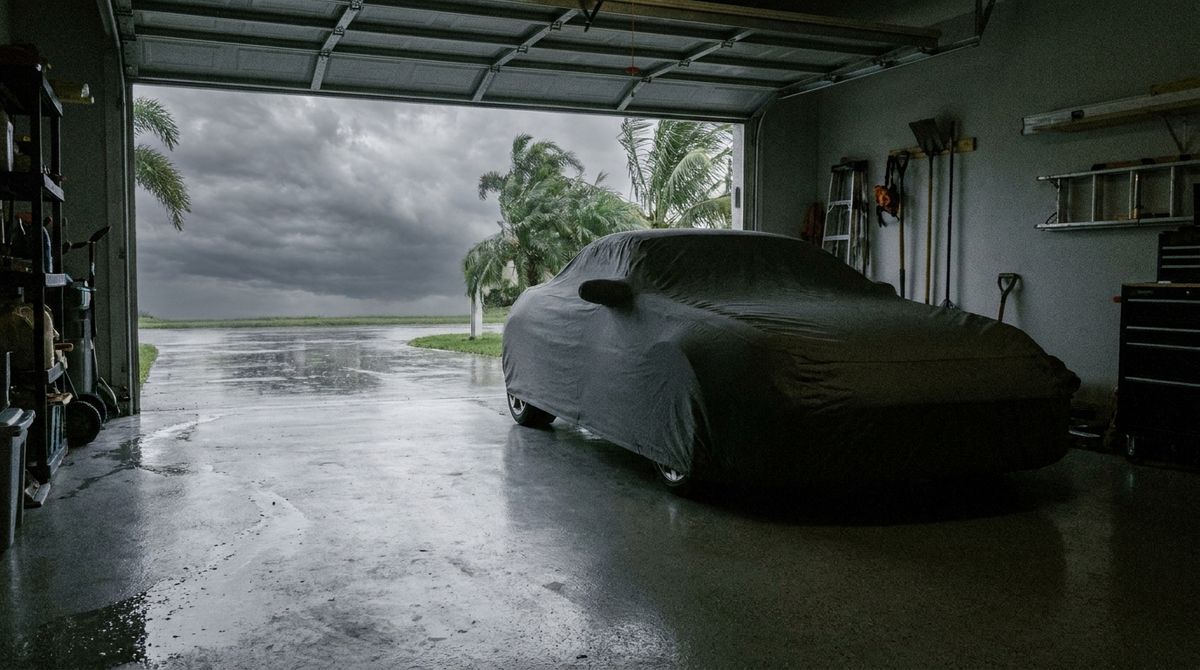
On September 16, 2022, a man in Southwest Florida posted that he had just bought a yellow McLaren P1 with about 300 miles on it. Twelve days later Hurricane Ian came ashore at Cayo Costa as a category 4 storm. The surge filled his garage in Bonita Springs and pushed the car out into the street, where a video of it floating went around the world. By December the same car was on Copart's lot in Punta Gorda with a certificate of destruction for a title. The last bid shown before the listing closed was $327,000. Copart's own estimate of the car undamaged was $2.3 million.
I do not know how that car was insured, and nothing public says. What I can tell you is that the gap between those two numbers was settled by one line on a policy, and it was settled the day the policy was written, not the day of the storm. If you keep a car in the third bay on the Gulf Coast, that line is the thing to read.
Three policies, one car, three checks
Put the same car on three different policies and the total loss pays three different ways.
Agreed value. The owner and the carrier settle on a figure when the policy is issued, and that figure is what a covered total loss pays, less any deductible. No depreciation and no negotiation after the storm. Hagerty, one of the large collector car insurers, sells this as Guaranteed Value and describes it in those terms on its own site.
Stated value. It sounds the same and it is not. The owner states a number, the premium is charged on that number, and at the claim the carrier may pay the stated amount or the car's actual cash value, whichever is lower. The stated figure is a ceiling. It is not a promise.
Actual cash value. This is what a regular family auto policy pays. In Florida the method is in the statute. Section 626.9743(5) says that when a policy settles total losses on actual cash value, the insurer may elect "a cash settlement based upon the actual cost to purchase a comparable motor vehicle." For a three-year-old SUV that works, because there are a hundred comparable SUVs for sale within a short drive. McLaren built 375 P1s. For a car like that, or a restored 1967 anything, "comparable" is where the argument starts, and the owner is having that argument after the loss, with no car.
A collector car belongs on agreed value. The other two leave the number open until the worst possible moment to discuss it.
Why it was a car claim and not a flood claim
People assume a car that floods in the garage is a flood insurance claim. It is not. The National Flood Insurance Program lists what it will not pay for no matter what caused the flooding, and cars and most self-propelled vehicles, including their parts, are on that list. A flood policy on the house pays for the house.
A car that takes on water is a comprehensive claim on the auto policy that lists it. That means the collector policy is the only policy standing between surge and the full value of the car, and it is why the carrier asks so many questions about the garage.
The National Hurricane Center's report on Ian puts the maximum inundation in Estero, Bonita Beach, Bonita Springs and North Naples at 8 to 12 feet above ground level. No garage door holds that. Fox News reported that the garage flooded and that the house was lost as well. The lesson is not that he should have had a better door. The lesson is that on this coast the car's hurricane exposure is the building's hurricane exposure, and the policy has to be written knowing that.
The twelve days
The detail in that story that should bother a collector is the timing. The car had been his for less than two weeks.
A new purchase is the easiest car in the collection to leave underinsured. Most auto policies extend some coverage to a newly acquired car for a short window, counted in days, and usually on the terms already on the policy. If the existing policy is a family auto policy on actual cash value, that is what the new car gets until someone changes it. An agreed value has to be set with the carrier, in writing, with the purchase documents or an appraisal behind it.
There is a second timing problem in Florida. Carriers stop binding new coverage and stop accepting increases once a named storm is threatening the state. That is standard practice across the market. A car bought in September can be a car that cannot be scheduled properly until the storm has passed.
So the order matters. The agreed value and the binder come before the transporter unloads the car, not the week after.
Mileage and use
A collector policy is priced for a car that is not driven much, and the terms say so. Hagerty's published guidance is that 3,500 miles a year or fewer is typical for a collectible vehicle, that up to 7,500 may be considered, and that the main requirement is that the car is not a daily driver. Other collector programs set their own tiers. All of them expect the household to have a regular car on a regular policy for errands and commuting.
That is also why the collector car does not go on the family auto policy. The family policy rates it as if it were driven every day and then pays actual cash value on it. You pay more to be covered for less.
One more Florida point. The state will register a private-use vehicle that is 30 or more years past its model year with an antique plate under section 320.086. The plate is a registration fact. It does not change what the insurance policy pays, and a car does not need to be 30 years old to be written on a collector policy.
What to check this week
Pull the declarations page for every car in the garage. Look for the words agreed value. If it says stated value or stated amount, or says nothing, you have a ceiling or a depreciated number.
Check the figure against the market. An agreed value set four years ago is four years old. Review it at every renewal.
Ask what the policy says about a named storm. Where the car is kept, whether there is a plan to move it, and whether the carrier pays anything toward moving it.
Tell the agent before you buy the next one. Not after.
Make sure every car is on the umbrella application. A car the umbrella carrier does not know about is a car the umbrella may not answer for.
The collector car insurance page covers how a collection is placed on the Gulf Coast, including Florida's PIP and uninsured motorist rules. The high-value home page covers the private-client carriers that write the cars inside the household program, and the flood page covers what a flood policy does pay for.
Sources
- Fox News, "Hurricane Ian video shows McLaren floating in Florida floodwater," September 30, 2022: September 16 purchase, about 300 miles, Bonita Springs, garage flooded, house lost.
- The Drive, "That McLaren P1 Flooded Up to Its Doors Just Sold at a Salvage Auction," December 16, 2022: Copart listing in Punta Gorda, certificate of destruction, last displayed bid $327,000, Copart undamaged estimate $2.3 million.
- Carscoops, November 10, 2022: garage door failure, 375 cars built.
- National Hurricane Center, Tropical Cyclone Report, Hurricane Ian (AL092022): Cayo Costa landfall September 28, 2022 at category 4 intensity; inundation of 8 to 12 feet above ground level in Estero, Bonita Beach, Bonita Springs and North Naples.
- Florida Statutes, section 626.9743, Claim settlement practices relating to motor vehicle insurance, 2026 text: subsection (5), actual cash value total loss methods.
- Florida Statutes, section 320.086, 2026 text: antique plate at 30 years after the model year.
- FloodSmart, What's Covered: cars and most self-propelled vehicles are not covered by an NFIP policy.
- Hagerty, Classic Car Insurance, frequently asked questions, read November 2026: agreed value and stated value definitions, mileage guidance. Each carrier's policy wording governs.
General information, not legal advice. Coverage depends on the forms and conditions on your policy.
The point
A collector car on the Gulf Coast is one storm away from being a total loss, and what that loss pays is fixed by whether the policy says agreed value, stated value or nothing at all. Set the agreed value in writing before the car arrives, keep it current, and treat the garage as part of the risk.
Get a quote on this coverage.
Ten minutes on the application. Dennis reads it himself and responds the same business day in most cases.
Start the application →Hendrickson Insurance, (941) 957-2796, [email protected], FL License E095547.
Coverage descriptions are general. Actual coverage is governed by the terms, conditions, and exclusions of the issued policy. Availability varies by carrier and by state.
