
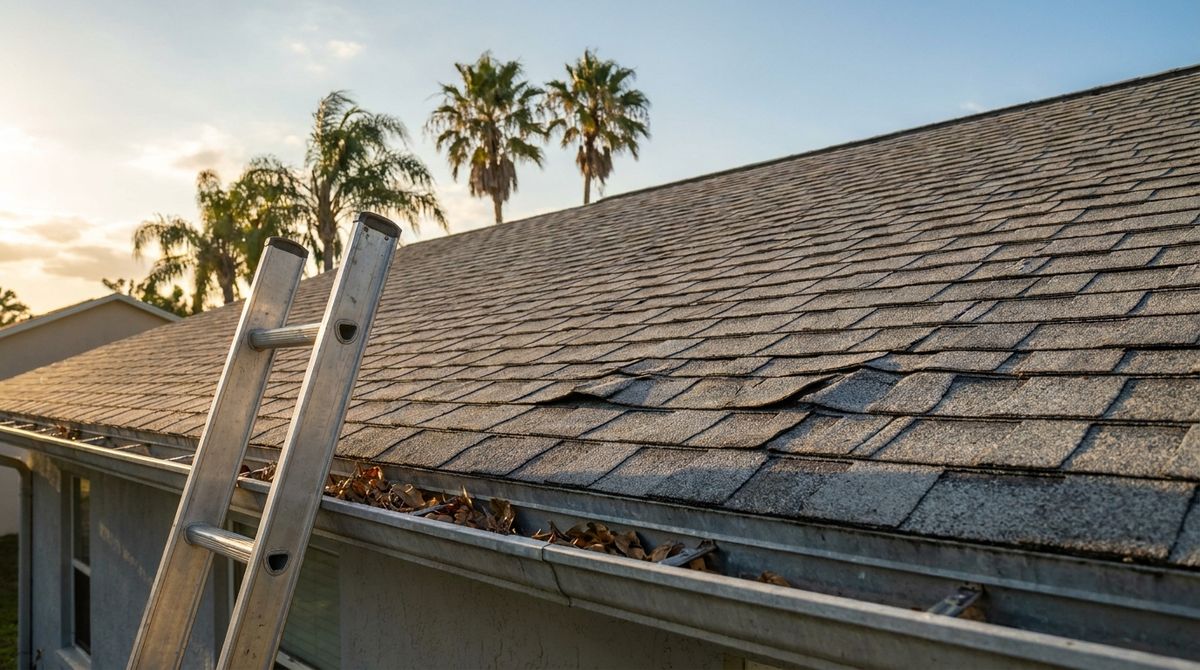
Take a Lakewood Ranch home built in 2010 with its original architectural shingle roof. In 2026 that roof is 16 years old. The house is in good shape, nothing leaks, there has never been a claim. The homeowners insurance comes up for renewal, or the house goes under contract and the buyer needs a policy to close, and the quote comes back declined or conditioned on a new roof.
That is not a carrier breaking the law. Florida Statute 627.7011(5) protects a homeowner from a roof age decline only while the roof is under 15 years old. At 15 the protection changes shape. It does not disappear, but it stops being automatic, and the homeowner has to prove the roof has life left. Most people find this out from the underwriter instead of in advance.
What the statute actually says
Florida added the roof age rule in the May 2022 special session, in SB 2-D, which became Chapter 2022-268. It applies to homeowners policies issued or renewed on or after July 1, 2022. There are two tiers.
Under 15 years old. An insurer "may not refuse to issue or refuse to renew" a homeowners policy on a home whose roof is less than 15 years old "solely because of the age of the roof." The key word is solely. Condition, damage, an open claim or a bad inspection are still fair grounds. Age alone is not.
15 years or older. The insurer must let the homeowner have the roof inspected "at the homeowner's expense before requiring the replacement of the roof." If that inspection shows the roof has 5 years or more of useful life remaining, the insurer may not refuse to issue or renew solely because of roof age.
So the 16-year-old roof in Lakewood Ranch is not dead. It is on the clock, and the burden has shifted to the owner.
Who counts as the inspector
The statute defines an authorized inspector as one "approved by the insurer." The list includes a licensed home inspector, a certified building code inspector, a licensed general, building, residential or roofing contractor, a professional engineer, an architect, or anyone else the insurer recognizes as qualified.
Read that first phrase again. Approved by the insurer. A report from someone the carrier does not accept does not help, so ask what the carrier will take before you pay for the inspection.
How roof age is counted
This is where people lose a few years without knowing it. The statute measures age from the last date 100 percent of the roof surface was built or replaced to the code in effect at the time. If the roof was replaced in sections, the clock starts at the first partial replacement, as long as the later work eventually covered the whole surface.
A patch after a storm does not reset the age. A partial reroof over a garage does not reset it. The permit for the full replacement is the document that matters, so find it before the underwriter asks for it.
The four-point inspection
The roof is one of four things underwriters want documented on an older home. The four-point inspection covers the roof, electrical, plumbing and heating and cooling, and reports the age, type and condition of each.
Citizens publishes its own thresholds, and private carriers often run close to them. Citizens requires a four-point inspection on property owner, dwelling and mobile home applications for homes more than 20 years old. Separately, a shingle or other soft roof older than 25 years, or a tile or metal roof older than 50 years, needs documentation showing at least five years of remaining useful life. If the roof has less than five years left, Citizens wants proof of a full roof replacement before the policy is written.
Private-client and standard carriers set their own rules, and they can be stricter than Citizens. The statute sets the floor for what they can do on age alone. It does not set their appetite.
The roof deductible nobody reads
The same 2022 law let insurers add a separate roof deductible under Florida Statute 627.701(10). It cannot exceed the lesser of 2 percent of the Coverage A limit or 50 percent of the cost to replace the roof. It applies only to claims adjusted on a replacement cost basis, and it does not apply to a hurricane loss, a total loss under the valued policy law, a tree or similar puncture through the roof deck, or a repair of less than 50 percent of the roof.
The insurer has to offer the right to opt out, and rejecting the deductible takes a signed form. At renewal it can be added only with a notice of change in policy terms. If a renewal packet arrives thicker than usual, that notice may be in it.
The 25 percent rule changed too
Owners of older homes used to hear that if 25 percent or more of a roof was damaged, the whole roof had to come off and be rebuilt to current code. Since the 2022 change to Florida Statute 553.844(5), that is no longer true for every roof. If the roof was built, repaired or replaced to the 2007 Florida Building Code or later, and 25 percent or more is being repaired, replaced or recovered, only the repaired portion has to meet the current code.
That matters for a Lakewood Ranch house built in 2010. If the roof permit shows it was built to the 2007 code or a later edition, a partial storm repair on that roof does not force a full tear-off to current code by itself. The permit tells you which side of that line the house is on.
What to do before the renewal
1. Find the permit. Pull the full-roof permit from the county. That date is the roof's age under the statute, not the date on the listing or what the seller remembers. 2. If the roof is 14, plan now. A roof that turns 15 during the next policy term moves into the inspection tier. Know which tier you will be in at renewal, not today. 3. If the roof is 15 or older, order the inspection first. Ask the carrier which inspectors it accepts, then get the report done before the application goes in. A report showing five or more years of useful life is the document that keeps age alone from being the reason for a decline. 4. Get the four-point and the wind mitigation report together. On an older home the underwriter wants both, and the wind mitigation report under Florida Statute 627.0629 is where the premium credits come from. One visit, two reports. 5. Read the roof deductible offer. Decide on it with the numbers in front of you. Do not let it default in.
The Lakewood Ranch page covers how homes there get written, and the high-value home insurance page covers the private-client side. If the private carriers say no, the Citizens post covers what comes next and how to get back out.
Sources
- Florida Statute 627.7011 (Online Sunshine), current text, subsection (5): roof age, authorized inspector, how age is calculated, applies to policies issued or renewed on or after July 1, 2022.
- Florida Statute 627.701 (Online Sunshine), current text, subsection (10): separate roof deductible.
- Florida Statute 553.844 (Online Sunshine), current text, subsection (5): the 2007 Florida Building Code roof exception, added by Chapter 2022-269.
- CS/SB 2-D, 2022 Special Session D (Florida Senate), Property Insurance, Chapter 2022-268.
- Citizens Property Insurance, Inspections, current four-point and roof inspection requirements.
General information, not legal advice. Coverage and eligibility depend on the carrier and the forms on your policy.
The point
Florida law keeps a roof under 15 years old from being the sole reason a home is declined, and gives an older roof a way back in through an inspection showing five years of life left. Find the permit date, order the inspection before the underwriter does, and read the roof deductible before it lands on the policy.
Get a quote on this coverage.
Ten minutes on the application. Dennis reads it himself and responds the same business day in most cases.
Start the application →Hendrickson Insurance, (941) 957-2796, dennis@hendricksonins.com, FL License E095547.
Coverage descriptions are general. Actual coverage is governed by the terms, conditions, and exclusions of the issued policy. Availability varies by carrier and by state.
