
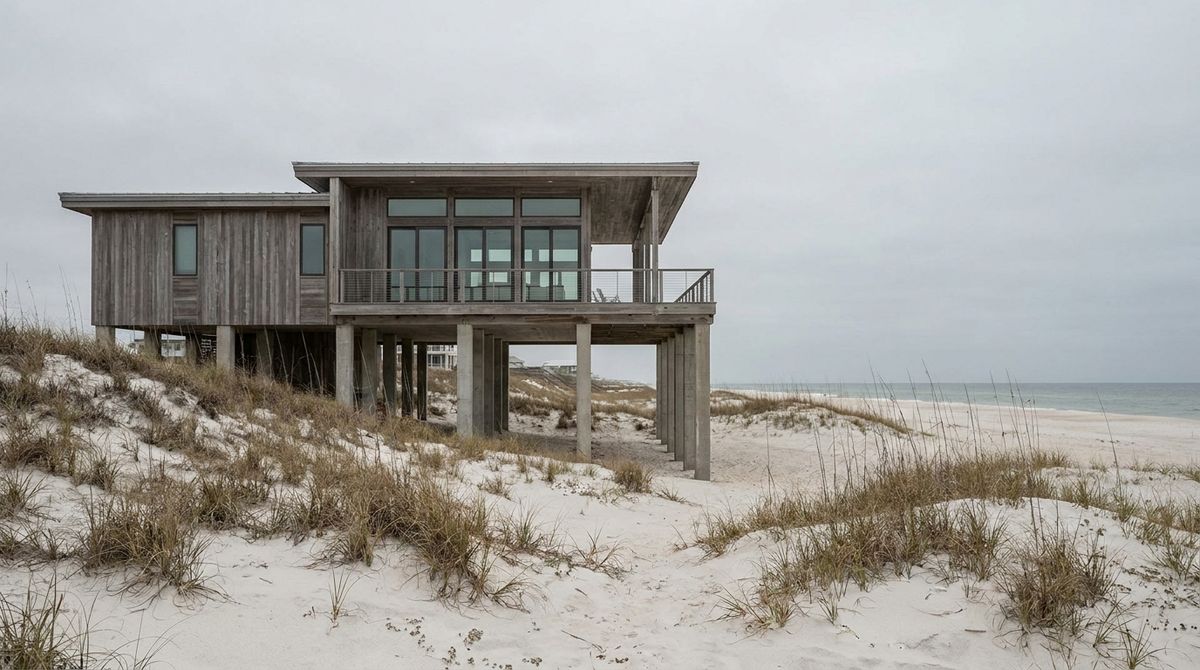
Every few weeks a Sarasota homeowner tells me the same thing: if the private carriers decline the house, they will just go to Citizens. On a Siesta Key or Longboat Key home, that plan usually does not exist. Florida law bars Citizens from insuring a personal residence that costs 700,000 dollars or more to rebuild. Outside Miami-Dade and Monroe counties, that is the ceiling, and Sarasota and Manatee are outside it.
Look at what a Gulf-front or bayfront house costs to rebuild today, not what it sold for, and most of them clear 700,000 dollars without trying. Those households are not one step away from the insurer of last resort. They are not eligible for it at all. And the ones who do fit under the cap are walking into a rulebook that tightens again on January 1, 2027.
What the statute actually says
Citizens Property Insurance Corporation exists under Florida Statute 627.351(6). It was built as the market of last resort, and the legislature has spent the last few sessions making sure it acts like one. Three rules matter for a homeowner on the keys.
The 700,000 dollar cap. Citizens may not insure a personal lines residential structure with a dwelling replacement cost of 700,000 dollars or more. The exception is counties where regulators found too little private competition, where the ceiling is 1 million dollars. Those counties are Miami-Dade and Monroe. Not ours.
The 20 percent rule. If an authorized private carrier offers comparable coverage at a premium no more than 20 percent above what Citizens would charge, the home is not eligible for Citizens. Agents run every new policy and every renewal through Citizens' Clearinghouse, which shops the risk against participating private carriers before Citizens will write or renew it.
The flood requirement. Since the 2022 special session (Senate Bill 2-A), a Citizens personal lines policy that includes wind requires the policyholder to carry flood insurance. It was phased in by the home's value: homes in FEMA special flood hazard areas first, then 600,000 dollars and up on January 1, 2024, 500,000 on January 1, 2025, 400,000 on January 1, 2026, and everyone else on January 1, 2027. Citizens does not sell flood. You buy it separately.
Why the cap catches high-value homes first
The cap is measured on replacement cost, the number on Coverage A. It is not the market value and it is not the tax roll. A three-bedroom house on Siesta Key built to current code, with impact glass, elevated on pilings, with a pool and a seawall, does not rebuild for 700,000 dollars. The construction cost alone is usually well past it before anyone prices the finishes.
Here is the trap I see. A homeowner gets a non-renewal from a private carrier, calls around, and someone suggests writing the house at a lower Coverage A to slide under the Citizens line. That is not a plan. It is underinsurance with a coinsurance clause attached, and it falls apart at the first real loss. If the house costs 1.4 million to rebuild and the policy says 690,000, the gap is yours.
So for a true high-value home, Citizens is off the table by statute. The question is what the real market looks like.
Where the high-value home actually goes
There are three places a home over the cap gets written, and they are not interchangeable.
Private-client carriers. These are the admitted carriers built for higher-value homes. I wrote about what gets a bayfront house placed with them in the Longboat Key private-client post. Roof age and type, wind mitigation features, elevation, distance to water, and the rest of the household's insurance all go into that decision. When they say yes, the coverage is usually broader than a standard homeowners form.
Admitted Florida carriers with a higher-value appetite. Some of the domestic Florida carriers will write above 700,000 dollars in some territories and decline in others. Appetite changes by season and by reinsurance year. This is where an agent who quotes the same house to several markets earns the fee.
Surplus lines. When admitted carriers decline, the house can be placed in the excess and surplus lines market, including Lloyd's syndicates. Surplus lines carriers are not covered by the Florida Insurance Guaranty Association, the forms vary more, and the deductibles and exclusions need a careful read. For some Gulf-front homes it is the honest answer, and I would rather put a client there with eyes open than leave them bare.
Often the real placement is split: wind in one place, everything else in another, and flood on its own policy. That is three documents to read, not one.
The homes that do fit under the cap
Plenty of Sarasota County homes and condos on the mainland do fit under 700,000 dollars, and some of them should be in Citizens for a while. If you are one of them, plan for these:
1. Flood is no longer optional. As of January 1, 2027, every Citizens personal lines policy that includes wind needs flood coverage behind it. If your renewal lands after that date and you have no flood policy, expect Citizens to require one before it renews. Remember also that the NFIP generally has a 30-day waiting period on a new policy, so do not wait for the renewal notice. 2. Buy the flood from the NFIP first. My rule is NFIP for primary flood, private flood only as excess above it. The NFIP does not non-renew a home because it had a claim. Private flood carriers can, and they have. All of Florida is a flood zone; the only question is whether yours is called high risk. 3. Expect to be shopped every year. The Clearinghouse and the takeout program exist to move homes back into the private market. If a comparable private offer comes in within 20 percent of the Citizens premium, you can lose eligibility. That is the system working as designed. Make sure the offer you are moved to is actually comparable on deductibles, roof settlement and water coverage.
Getting back out
Nobody plans to stay in Citizens. The way out is the same set of facts private underwriters care about: a newer roof, a current wind mitigation inspection under Florida Statute 627.0629, opening protection, a four-point inspection with no open issues, and a clean loss history. A house that gets a new roof and a fresh wind mit report can go from declined to quoted in one renewal cycle. Some of the takeout offers that land in a Citizens policyholder's mailbox are good. Some are from carriers you should look up before you say yes.
The point
On Siesta Key, Longboat Key and Anna Maria, Citizens is not the backup plan for a high-value home, because the statute does not let it be. The backup plan for a high-value home is an agent who knows which private-client, admitted and surplus lines markets will look at the house, with flood placed through the NFIP underneath. If your carrier sent a non-renewal, call before you shrink the Coverage A to chase a market that was never available.
Get a quote on this coverage.
Ten minutes on the application. Dennis reads it himself and responds the same business day in most cases.
Start the application →Hendrickson Insurance, (941) 952-7991, dennis@hendricksonins.com, FL License E095547.
Coverage descriptions are general. Actual coverage is governed by the terms, conditions, and exclusions of the issued policy. Availability varies by carrier and by state.