
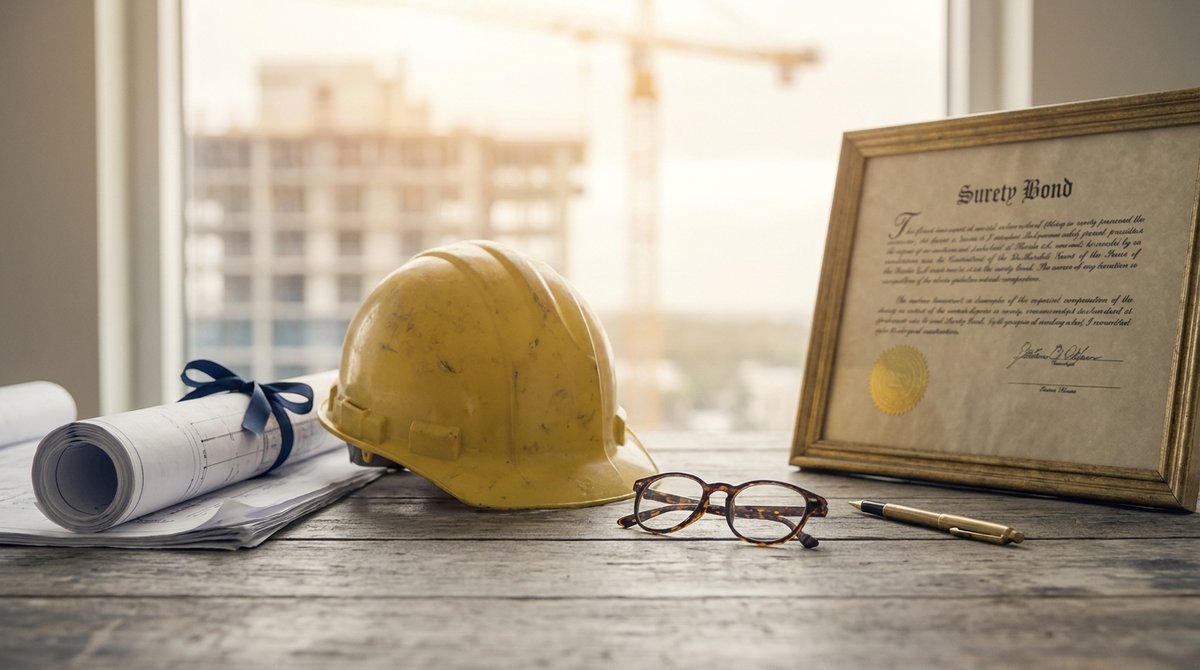
If you run a contracting business on the Gulf Coast of Florida, sooner or later a bond stands between you and the work. You cannot pull certain licenses without one, you cannot bid most public jobs without one, and on a lot of commercial contracts the owner will not let you break ground until the bond is in hand. Surety bonds are one of the most misunderstood parts of a contractor's insurance file, so let me walk through what they actually are, which ones you run into here in Florida, and how you get bonded without it turning into a fire drill every time a job comes up.
Start with the single biggest misunderstanding: a surety bond is not insurance for you. Your general liability, your commercial auto, your workers comp, those protect your business. A bond does the opposite. It protects the other side.
A bond is a guarantee, not a policy
A surety bond has three parties, not two. There is you, the contractor, called the principal. There is whoever is requiring the bond, a licensing board, a project owner, a city, called the obligee. And there is the surety, the company that backs the bond. The surety is not insuring you against a loss. It is vouching for you to the obligee, guaranteeing that you will do what you promised.
Here is the part that catches contractors off guard. If the surety ends up paying a claim, you pay the surety back. Every bond comes with an indemnity agreement, and the owners of the business usually sign it personally. So a bond is much closer to a line of credit than to an insurance policy. The surety expects to be made whole if you fail to perform, which is exactly why it looks so hard at whether you can perform before it ever puts its name behind you.
The bonds Florida contractors actually run into
There are a handful you will see over and over. Knowing which is which keeps you from getting blindsided when a job or a license renewal asks for one.
- License and permit bonds. Florida's contractor licensing, and a lot of city and county registrations, require a bond as a condition of holding the license or pulling permits. These are usually small, fixed-amount bonds, and they protect the public and the government, not you.
- Bid bonds. On competitive projects, the owner wants proof that if you win, you will actually sign the contract and provide the required bonds. A bid bond guarantees that. Back out after you win, and the bid bond covers the owner's cost to go to the next bidder.
- Performance bonds. This is the big one on public and larger commercial work. It guarantees you will complete the project according to the contract. If you default, the surety steps in to get the job finished, then comes to you for what it spent.
- Payment bonds. These guarantee your subcontractors and suppliers get paid. On Florida public projects they are required by law, and on private jobs owners use them to keep liens off the property.
- Maintenance or warranty bonds. These guarantee your work for a set period after the job is done.
A bond is not there to protect you. It is there to protect the people you make promises to, and you are the one who pays if a promise breaks.
The Florida rules that force the issue
Florida does not leave bonding to preference on public work. Under the state's public construction bond law, Florida Statute 255.05, often called the Little Miller Act, a contractor on a public project above a set threshold must furnish both a payment bond and a performance bond before starting work. No bond, no job.
On private projects the mechanism is different but the pressure is the same. Owners and lenders use payment bonds under Florida Statute 713.23 to protect the property from construction liens, because a proper payment bond gives your subs and suppliers a claim against the bond instead of against the building. And at the local level, plenty of Florida cities and counties require a permit or right-of-way bond before they will issue permits at all. The practical takeaway is simple. If you want to grow past small private jobs into public and larger commercial work on the Gulf Coast, bonding is not optional. It is the gate you have to walk through.
How you actually get bonded
Surety underwriting is not like buying a policy where you answer a few questions and get a price. The surety is extending you credit, so it looks at what underwriters call the three C's. Capital is your financial strength, your balance sheet, your working capital and cash on hand. Capacity is whether you can actually do the work, your experience, your track record on similar jobs, your crew and equipment. Character is your reputation and credit history, whether you pay your bills and finish what you start.
For small license and permit bonds this is light, often just your personal credit. For performance and payment bonds on real projects, the surety will want business financial statements, sometimes prepared by a CPA, your work in progress, bank and supplier references, and personal financials from the owners. The stronger that picture, the higher your bonding capacity, which is both the size of a single bond you can get and the total amount of bonded work you can carry at one time. Building that capacity is a big part of why the relationship matters.
What it costs
Bond pricing does not work like an insurance premium tied to your claims. License and permit bonds are usually a flat, modest cost. Performance and payment bonds are priced as a percentage of the contract amount, and that rate depends mostly on your financial strength and credit, generally landing somewhere in the range of one to three percent of the bond amount for a well qualified contractor. A stronger balance sheet and cleaner credit move you toward the low end. Either way, the bond premium is a real cost of doing the work, and you build it into your bid so it is covered, not absorbed.
Get your bonding line in place before you need it
The mistake I see contractors make is treating a bond like something you go find the week a job comes up. By then you are scrambling, the surety is asking for financials you do not have ready, and the bid deadline is closing on you. The better way is to establish a bonding relationship early. Get an agent and a surety who understand your business, and set up a bond line, an approved capacity, so that when a project lands on your desk you can produce the bond quickly and bid with confidence instead of praying it comes through in time.
That relationship also grows with you. As your financials strengthen and your track record builds, your capacity goes up, and you can go after bigger and better work. Bonding stops being the thing that holds you back and becomes a tool you use on purpose.
That is exactly the kind of thing we handle for contractors on the Gulf Coast. We place the license and permit bonds, bid bonds, and performance and payment bonds, we make sure your general liability and the rest of your commercial coverage line up with what the bond and the contract require, and we help you build the financial picture that earns you more bonding capacity over time. If you are a contractor in Sarasota, Bradenton, Tampa, or St. Petersburg and bonding has been slowing you down, that is a conversation worth having before your next bid, not the week it is due.