
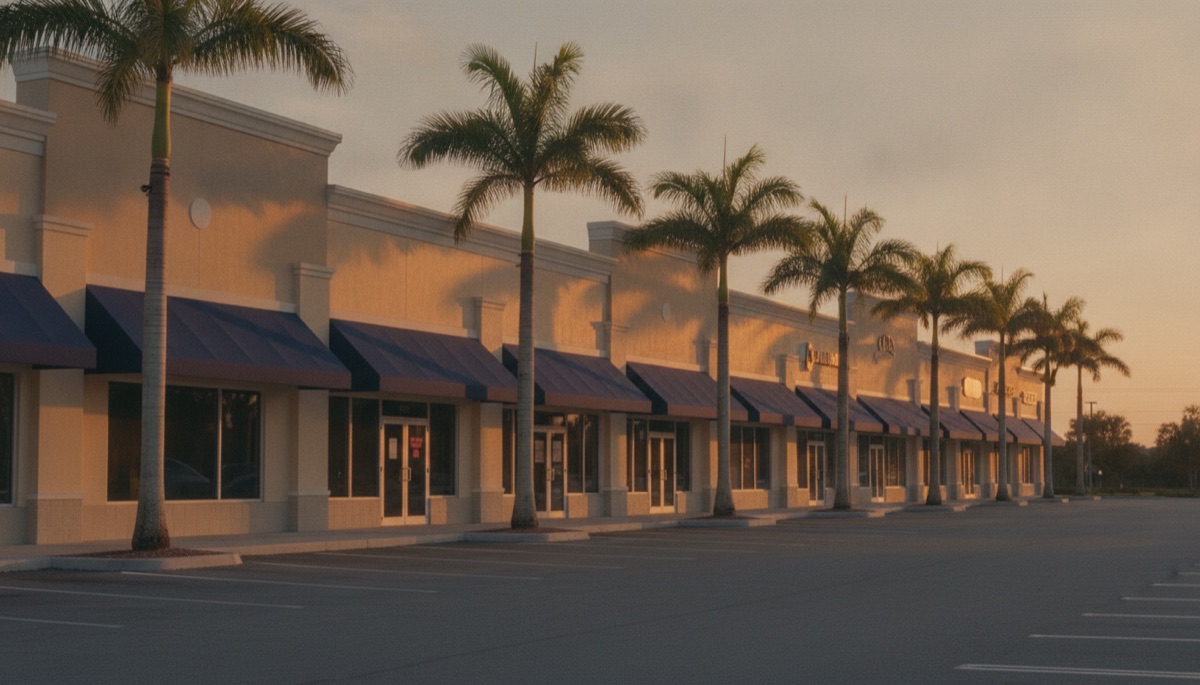
If you own a strip mall or retail plaza on the Florida Gulf Coast, the first question you ask about insurance is usually the same one: what is this going to cost me. It is a fair question and a frustrating one, because strip mall insurance in Florida does not come with a sticker price. Two plazas of the same square footage, a few miles apart, can carry premiums that differ by tens of thousands of dollars a year. I managed shopping centers before I wrote insurance, and I quote strip mall insurance in Florida across Sarasota, Bradenton, and the rest of the Gulf Coast. Let me walk you through what actually sets the number and where you have room to move it.
It is priced per building, on replacement cost, not what you paid
The first thing to understand is that the biggest piece of your premium, the property side, is built off the cost to rebuild the structure. Not the market value. Not what you paid for the plaza in 2015. Not what a broker thinks it would sell for today. The insurer wants to know what it would cost to put the building back up if it burned to the ground or a hurricane took the roof off, and it rates the policy on that replacement cost. A masonry plaza that would cost three million dollars to rebuild is rated on that three million, and the building value drives most of the number.
Owners sometimes try to save money by insuring the building for less than it would cost to rebuild. That backfires at claim time. Most commercial property policies carry a coinsurance clause, which penalizes you at a partial loss if you carried too little coverage going in. You save a little on premium every year and then eat a penalty on the one claim that matters. Insure the building for what it actually costs to rebuild, and do not chase a lower premium by shrinking the value on paper.
What actually drives the premium
Once the building value is set, a stack of factors pushes the rate up or down. These are the ones that move the number the most:
- Location and wind zone. How close you are to the coast is the single biggest lever on the Gulf Coast. Wind exposure drives Florida property rates more than almost anything else.
- Flood zone. All of Florida is a flood zone, hazardous or non-hazardous, and where your plaza sits on that map changes both your rate and whether you need a separate flood policy on top.
- Building age and roof age. An older building costs more to insure, and the roof is the piece carriers care about most. A twenty-year-old roof is a red flag in a hurricane state.
- Construction type. Masonry and concrete block rate better than wood frame. Fire and wind both behave differently on a block building than a frame one, and the pricing follows.
- Square footage and replacement cost. Bigger building, bigger number. This is the base the rate multiplies against.
- Tenant mix. Who occupies the units changes the risk. A restaurant with a fryer, a dry cleaner, a nail salon, an auto shop, each raises the hazard.
- Occupancy and vacancy. A fully leased plaza rates better than one with dark units. Vacant space is a liability and a fire risk, and carriers price it that way.
- Claims history. A clean loss run keeps you in better markets at better rates. A string of claims narrows your options fast.
- Deductible. What you agree to carry yourself, especially the named-storm deductible, moves the premium directly.
A couple of these deserve more than a line. Wind is the one you cannot argue with. A plaza a mile from the water and a plaza fifteen miles inland are not the same risk to a carrier, and the rate reflects it no matter how well built either one is. Pair that with roof age, because after a few bad storm seasons Florida carriers got strict: many will not write or renew a building with an old roof at all, and the ones that will charge for the privilege. If your roof is past fifteen years, that alone can be the difference between a competitive quote and a hard decline.
Tenant mix is the factor owners underestimate most. A row of quiet offices, a hair salon, and an insurance agency is a light risk. Add a restaurant with a commercial fryer and a dry cleaner with solvents, and the same building becomes a different animal. Grease fires and chemical exposures drive both property and liability pricing, and they raise the stakes on your general liability as much as your building coverage. This is why I read the rent roll before I quote. The building tells me half the story and the tenants tell me the rest.
Occupancy and claims history quietly set your ceiling. A plaza that is fully leased reads as a healthy, watched-over property, and it rates that way. A plaza with two or three dark units reads as a fire and vandalism risk that nobody is walking every day, and carriers load the rate for it or decline it outright. Your loss history works the same way. A clean run of years with no claims keeps you in the strongest markets at the best pricing. A pattern of water losses, slip-and-falls, or storm claims narrows your options to fewer carriers who charge more, and in a hard Florida market that can be the whole ballgame. These two factors do not show up on the building at all, but they decide which markets will even look at you.
So what does it actually cost?
Here is where I have to be honest instead of clever. Anyone who quotes you a firm price for strip mall insurance without seeing your building, your location, your roof age, and your rent roll is guessing, and the guess will be wrong. What I can give you is direction. A clean, newer masonry plaza sitting inland in a lower-hazard spot, fully leased with a light tenant mix, rates far lighter per square foot than an older frame building near the coast with a restaurant tenant and a roof pushing twenty years. The gap between those two is not a few percent. It is a different order of magnitude.
The property coverage is the bulk of the bill. Liability sits on top of it, and for smaller plazas the two are often bundled into a business owner's policy, which packages property and general liability together and usually prices better than buying them separately. On the Gulf Coast your named-storm or hurricane deductible is quoted as a percentage of the building value, not a flat dollar figure, so on a three million dollar building a two percent wind deductible is sixty thousand dollars out of your pocket before the policy pays a storm claim. That number belongs in your planning, not just your policy. The only way to get a real figure for your property is to have someone rate it, which costs you nothing but a phone call.
How to bring the number down
You do not have to accept the first quote as fixed. Several of the factors above are ones you can influence, and a few of them move the premium meaningfully:
- Get a wind mitigation inspection. If your building has roof straps, a hip roof, opening protection, or a newer roof deck, an inspection documents it and can earn real credits on the wind portion of the premium. Undocumented, those features do you no good.
- Update the roof. A new roof is the single biggest thing you can do to open up better markets and lower the rate. It also keeps carriers willing to renew you at all.
- Watch your tenant mix. Vet new tenants for the hazard they bring, and make high-hazard tenants carry their own strong liability limits and name you as additional insured. A better mix is a better rate.
- Take a higher deductible. If you have the reserves to absorb a larger deductible, raising it lowers your premium. Just make sure you can actually cover it, especially the percentage-based wind deductible.
- Bundle property and liability. A packaged policy usually beats buying the pieces one at a time, and it closes gaps between coverages.
- Keep it leased and keep it clean. Full occupancy and a clean claims history are two of the cheapest things you can bring to the table, and they keep you in the better markets year after year.
None of this is complicated, but it is specific to your building, and that is the point. The right way to find out what your plaza costs to insure and where you can shave the number is to have someone who has stood on the owner's side of the table rate it against real markets. If you own a strip mall or retail plaza on the Gulf Coast and you want a straight answer on what it should cost, look at our strip center insurance page or call 941-957-2796 and we will price it and walk through where you can move the number together.