
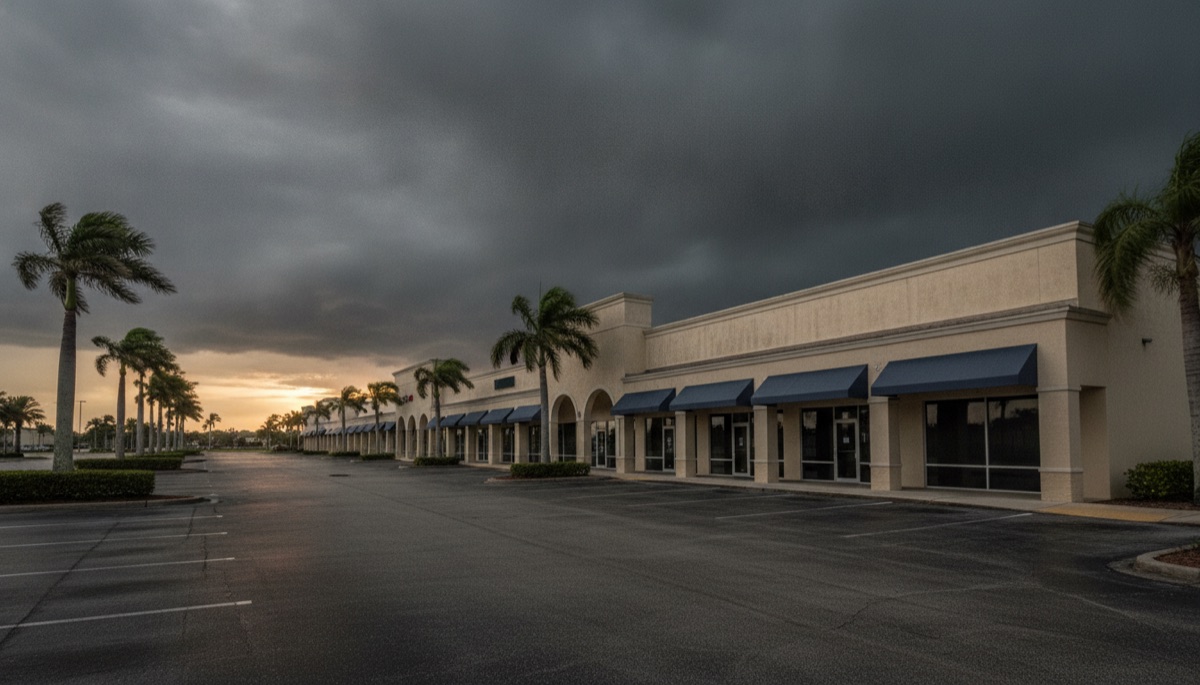
Every Florida strip mall policy has two deductibles hiding inside it. There is the all-other-perils deductible, the flat number that applies when a pipe breaks or a car drives through a storefront. Then there is the one nobody reads until a storm is in the Gulf: the named-storm or hurricane deductible. That is the number that decides whether a claim is worth filing, and it is almost always much larger than owners expect.
I have managed shopping centers, and I write strip center and retail plaza insurance across the Gulf Coast. The single most common surprise I see is an owner who thinks their deductible is 10,000 dollars, files after a hurricane, and learns the deductible on that loss is 100,000 dollars or more. Nothing about the policy changed. They just never had the percentage explained to them. Let me fix that here.
Named storm deductibles are one piece of the bigger picture. See our full retail plaza insurance Florida guide for building coverage, coinsurance and the other decisions that come with owning a plaza.
A named-storm deductible is a percentage, not a dollar amount
On Florida commercial property, the hurricane deductible is written as a percentage of the insured value, not a fixed dollar figure. It is usually 2, 3, 5, or 10 percent. The percentage applies to the building limit, and on some policies to the combined building and business personal property limit. That distinction matters, so read your declarations page for the exact wording.
Here is the math on a plaza insured for 2 million dollars in building value:
- 2 percent deductible: 40,000 dollars out of pocket before coverage responds
- 5 percent deductible: 100,000 dollars out of pocket
- 10 percent deductible: 200,000 dollars out of pocket
That is per storm, and it applies to the building value, not to the size of the loss. A 250,000 dollar roof claim on a plaza with a 5 percent deductible pays 150,000 dollars. The owner covers the first 100,000. If you did not budget for that, the claim can hurt almost as much as the storm.
What counts as a named storm
The hurricane or named-storm deductible triggers when the National Hurricane Center names a storm and it affects your area, usually from the time a watch or warning is issued until 72 hours after it is lifted. Outside that window, a wind or hail loss falls under the smaller all-other-perils deductible. This is why the timing of the damage, and the documentation of it, matters on a Florida claim. A tree through the roof the week before a named storm forms is a very different deductible than the same damage during the storm.
Higher deductible, lower premium, and the tradeoff nobody explains
Carriers let you pick the percentage, within limits, and the choice moves your premium. A 10 percent named-storm deductible buys a noticeably cheaper policy than a 2 percent one. In a hard Florida market, where every retail plaza premium has climbed, the temptation is to take the higher deductible to make the number work.
That can be the right call, but only if you actually have the cash or a line of credit to cover the deductible when a storm comes. I have seen owners take a 10 percent deductible to save on premium, then discover after a hurricane that they cannot fund the 200,000 dollar deductible, so the coverage they paid for years to keep does not help them rebuild. The deductible you choose is a financing decision as much as an insurance one. Pick the number you can write a check for.
The lease angle: who actually pays the deductible
On a retail plaza, the deductible question does not stop with the landlord. Most shopping center leases, especially triple-net leases, address casualty and who bears the cost of the deductible on a shared loss. Some leases let the landlord pass a share of the deductible through to tenants as a common area or casualty expense. Others leave it entirely with the owner. If your lease is silent or vague, you are the one holding the 100,000 dollars.
This is where retail plaza insurance and lease language have to be read together, not separately. When I review a plaza, I look at the commercial property deductible and the lease casualty clause side by side, because the policy tells you what is owed and the lease tells you who owes it. Getting those two documents to agree is one of the highest-value things a shopping center owner can do before storm season, and it costs nothing but an afternoon.
Business income is the loss owners forget
The named-storm deductible applies to physical damage, but the bigger number after a hurricane is often the income you lose while the plaza is closed. If half your tenants cannot open for three months because the roof is torn off and the units are gutted, rent stops or abates, and your mortgage does not. Business income and extra expense coverage is what fills that gap, and it carries its own waiting period, usually 72 hours, before it starts to pay.
For a retail plaza, business income coverage is not optional. It is the difference between surviving a slow rebuild and defaulting during one. Pair it with the physical property limit and make sure the income limit reflects your real annual rent roll, not a number someone guessed at when the policy was first written.
Flood is a separate policy, and it has no percentage deductible
One clarification that saves owners a lot of grief: the named-storm deductible on your property policy covers wind. It does not cover flood. In Florida, storm surge and rising water are excluded from the commercial property policy and require separate commercial flood insurance. All of Florida is a flood zone, hazardous or non-hazardous, so a coastal plaza needs both the wind coverage with its percentage deductible and a flood policy with its own flat deductible. After a hurricane, the adjusters will draw a line between wind damage and water damage, and which policy pays depends on which side of that line the loss falls. Carrying both is how you avoid the gap.
What to do before the next storm
You do not need to become an insurance expert. You need to know four numbers and one clause:
- Your building limit. The deductible is a percentage of this, so know it.
- Your named-storm percentage. Read it off the declarations page, not from memory.
- The dollar deductible that percentage produces. Multiply and write it down. That is your out-of-pocket number per storm.
- Your business income limit. Confirm it matches your actual rent roll.
- Your lease casualty clause. Know whether the deductible is yours alone or shared with tenants.
If you cannot fund the deductible number you find, you have two choices: lower the percentage and pay more premium, or arrange financing now, before a storm, while you have time. Both are fine. Being surprised by it in the parking lot after a hurricane is not.
Retail plaza coverage is our specialty, and the general liability, property, and lease-compliance side of a shopping center all connect. If you want a second read on your named-storm deductible, your business income limit, and how your lease handles casualty, that is exactly the review I do. You can look at our strip center insurance and general liability pages, or just call 941-957-2796 and we will walk through your declarations page together.