
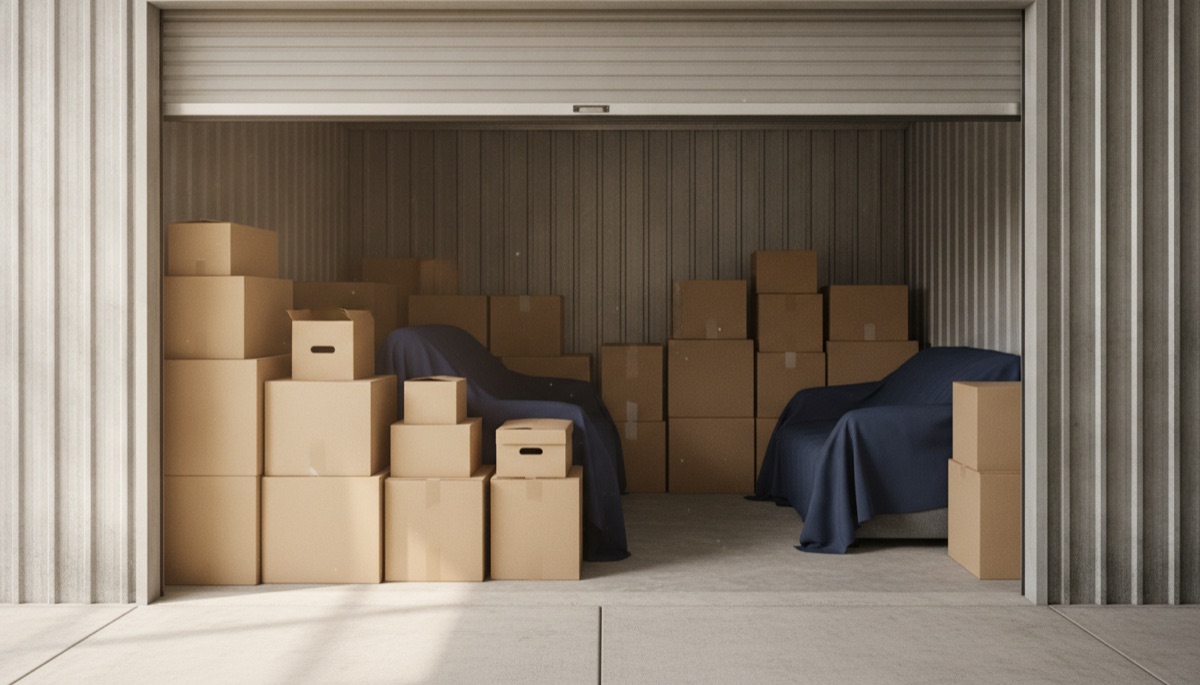
If you rent a storage unit anywhere on Florida's Gulf Coast, the belongings inside are usually covered by your homeowners insurance or renters policy, but only up to a limit that surprises most people the day they file a claim. That coverage is real, and it is also thinner than the pile of furniture, appliances, and boxes sitting in the unit. Understanding exactly how it works, and where it stops, is the difference between a claim that pays and a loss you eat.
I write personal lines coverage for families across Sarasota, Bradenton, and the rest of the Gulf Coast, and the storage unit question comes up constantly. People move, downsize, inherit a houseful of furniture, or run out of garage space, and a rented unit becomes the overflow attic. Then they assume the facility insures it, or that their home policy covers it in full. Both assumptions are usually wrong, and both are easy to fix once you know what you are looking at.
Your home or renters policy follows your stuff off-premises
Standard homeowners, condo, and renters policies include what is called off-premises or off-site personal property coverage. In plain terms, your belongings are covered even when they are not in your home, including in a storage unit. That is the good news. The catch is the sub-limit. Most policies cap off-premises property at roughly ten percent of your total personal property limit. If your policy insures your contents for 100,000 dollars, the belongings in your storage unit may only be covered up to about 10,000 dollars.
For a unit holding a couch, a mattress set, some boxes, and a bicycle, ten percent might be plenty. For a unit holding the full contents of a three-bedroom house during a move, or a woodworking shop's worth of tools, ten thousand dollars does not come close. The coverage is there. It is just capped at a number that has nothing to do with what you actually stored.
The other detail worth knowing is that the same perils that apply to your home apply to the unit. If your policy covers fire, theft, and windstorm at the house, it generally covers those in the unit too, subject to the sub-limit and your deductible. Renters especially should not skip this. A renters policy is inexpensive, and it is often the only thing standing between you and a total loss of everything in storage.
The storage facility does not insure your belongings
This is the single biggest misunderstanding, so read the rental contract you signed. The facility carries insurance on the building and on its own liability. It does not insure the contents of your unit, and the lease almost always says so in plain language. The standard rental agreement makes you responsible for your own goods and specifically disclaims the facility's responsibility for loss or damage to what you store, even from causes you might assume are their problem.
Many facilities will offer you a protection plan or tenant insurance at the counter for a monthly fee. Sometimes that is a reasonable stopgap, but read what it actually covers before you buy. These plans often carry low limits, long exclusion lists, and their own deductibles, and they only cover the one unit. In a lot of cases you are better served by extending coverage you already understand through your own agent than by adding a standalone facility plan you have never read.
It is also worth knowing why the facility structures it this way. A storage operator is renting you square footage, not taking custody of your property the way a bailee would. They have no idea what is behind your door, what it is worth, or how you packed it, so they contract out of responsibility for it entirely. That is standard across the industry and it is not going to change. The practical takeaway is simple. Nobody at that address is protecting your belongings but you, and the coverage that does it is the policy you already own or the one you should.
Florida exclusions: humidity, mold, and flood
Florida adds problems that a storage unit in a dry climate never faces, and they land squarely in the exclusions. Humidity is relentless here. A non-climate-controlled unit can run warm and damp for months, and the mold, mildew, and moisture damage that follows is typically excluded on both homeowners policies and facility plans. Insurers treat that kind of gradual damage as maintenance and wear, not a covered sudden loss. If you are storing anything vulnerable to moisture, pay for a climate-controlled unit. That is risk control the policy will not do for you.
Flood is the bigger one. All of Florida is a flood zone, hazardous or not, and flood damage is excluded from every standard homeowners and renters policy. If a storm surge or heavy rain floods the storage facility, your off-premises contents coverage does nothing, because flood is not a covered peril to begin with. Flood needs its own policy. Most people do not carry a separate flood policy on a rented unit, which means water on the floor of that unit is very often an uninsured loss. If the contents matter and the location floods, that gap has to be addressed on purpose, not assumed away.
High-value items need to be scheduled or covered separately
Even under the sub-limit, certain categories have their own internal caps. Jewelry, watches, firearms, fine art, collectibles, and cash are usually limited to a few thousand dollars regardless of your overall contents limit, and those caps apply in the unit the same as in the house. Business inventory and tools used for work are another common trap. Personal policies limit or exclude property held for business use, so a contractor storing equipment or a reseller storing stock may have far less coverage than they think.
The fix for genuinely valuable items is to schedule them, meaning list them individually on a personal articles or valuable items policy at their appraised value. Scheduled items are covered at their real worth, usually with no deductible and against a broader set of causes. For high-value collections, tools, or business property, a separate policy is the honest answer rather than hoping the storage sub-limit stretches to cover them. If your total exposure across your home and stored belongings is large, an umbrella policy is worth a conversation too, since it adds a layer of liability protection above your underlying limits.
People underestimate how quickly a unit adds up. Two mattress sets, a dining table and chairs, a couple of dressers, a television, a bicycle or two, power tools, and forty boxes of household goods can easily clear twenty or thirty thousand dollars to replace at today's prices. That is well past a typical ten percent off-premises cap, and it is exactly the kind of number that turns a covered claim into a disappointing one. The point of running the math before you lock the door is that raising a limit costs a few dollars a year. Discovering the gap after a fire or a break-in costs whatever the policy would not pay.
How to actually cover a storage unit the right way
None of this is complicated once you treat the unit as what it is, an extension of your household that happens to sit somewhere else. A few practical steps close almost every gap:
- Inventory the unit before you lock it. Photograph or video everything, keep receipts for the big items, and store the list somewhere other than the unit. Claims move faster when you can prove what was there.
- Add up the real value and compare it to your sub-limit. If the off-premises cap on your policy will not cover the contents, ask your agent to raise the limit or write coverage that fits the unit.
- Choose climate-controlled for anything moisture can ruin. Humidity and mold damage are excluded, so control the risk the policy will not.
- Address flood on purpose. If the facility sits where water collects, talk about a separate flood policy rather than assuming your home policy reaches it.
- Schedule the valuables. Jewelry, tools, collectibles, and business property belong on their own coverage, not under a capped sub-limit.
The belongings in a storage unit are worth insuring on purpose, not by accident. If you are not sure what your current policy actually extends to that unit, or whether the limit fits what you put in it, that is a five-minute review and an easy fix. Read our homeowners insurance page or call 941-957-2796 and we will look at your policy, your unit, and the gap in between, and get it covered before you need it.