
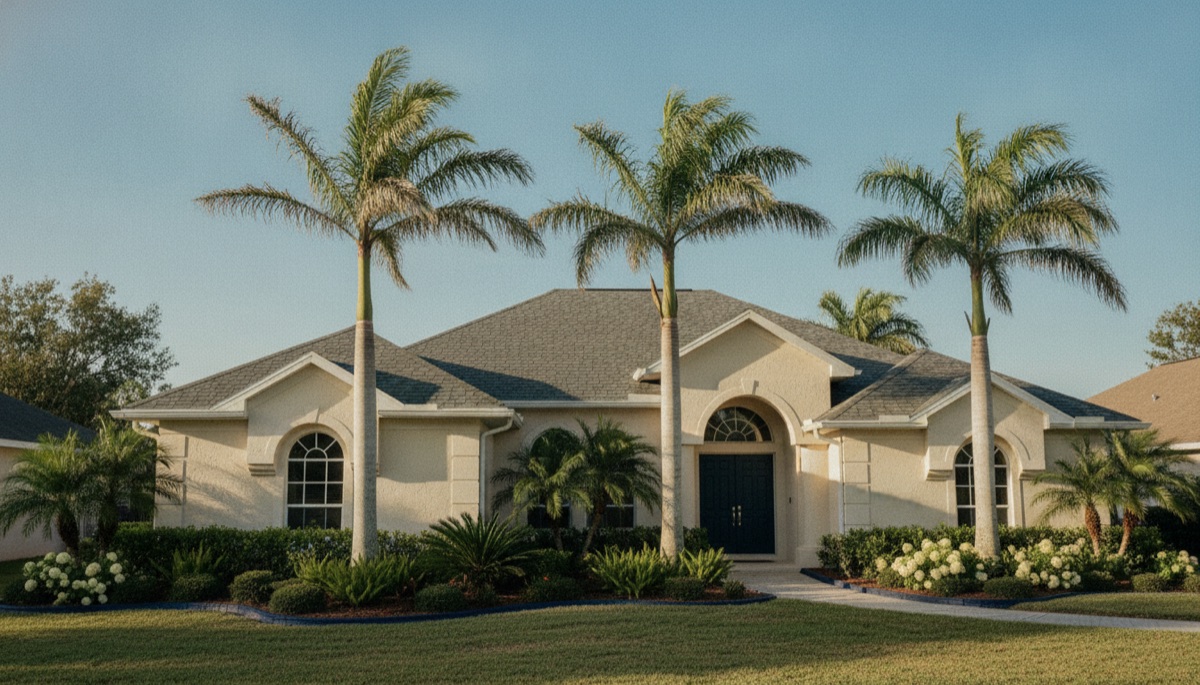
If you own a home anywhere on the Florida Gulf Coast, you already know homeowners insurance costs more here than almost anywhere in the country, and you have probably watched the premium climb in years you filed no claim at all. The question owners ask me most is simple: what am I actually paying for, and what can I do about it? The honest answer is that a short list of specific factors drives most of the number. Understand them and you stop treating your renewal like weather you cannot control.
I write Florida homeowners insurance for owners across Sarasota, Bradenton, and the wider Gulf Coast, and I am independent, which means I am not defending any one carrier's rate. So here is the plain version of what moves your price, in the order that matters.
Your roof is the single biggest factor
Nothing on your policy moves the number like your roof. In Florida, the roof is what stands between the wind and everything you own, so carriers underwrite it harder than any other part of the house. Two things matter most: how old the roof is, and what it is made of.
Age comes first. Many carriers in Florida simply will not write a roof older than about 15 years, and some draw the line even sooner on certain materials. Once a roof crosses that age, your options narrow fast, the premium jumps, and you may be pushed toward a policy that only pays the depreciated value of the roof instead of the cost to replace it. A newer roof does the opposite. It opens up more carriers, earns better pricing, and often qualifies for coverage that pays full replacement cost.
Material matters too. A hip roof sheds wind better than a gable, and the covering, whether it is shingle, tile, or metal, along with how it was attached to the structure, all feed into the rate. You cannot change the shape of your roof, but if yours is aging, a replacement is not just a repair. It is one of the few moves that can lower your premium and widen your choices at the same time.
Wind mitigation: the inspection that pays for itself
If you take one thing from this article, take this. A wind mitigation inspection is the cheapest money you will ever spend on your home insurance, and most Florida owners either skip it or let an old one expire.
A licensed inspector spends an hour at your house documenting the features that help it survive a storm: the roof-to-wall connections, whether the roof deck is nailed to current code, the shape of the roof, the age of the covering, and whether you have a secondary water barrier or impact-rated openings. Every one of those features that checks out becomes a credit on your policy, and in Florida those credits are mandated. The carrier has to give them to you if the report supports them.
The savings are real, and they are not one-time. They ride on the policy year after year. A wind mitigation report is also good for several years, so one inspection can pay you back many times over before it needs redoing. If you have never had an inspection, get one. If your last report is several years old or predates a roof replacement, get a fresh one, because it may now show credits your current policy is not giving you. I have seen owners cut hundreds off a renewal on the strength of a single afternoon inspection, and the report follows the house, so it helps at resale too.
The 4-point inspection on older homes
If your home is older, usually more than about 30 years, a carrier will often ask for a 4-point inspection before it agrees to write or renew you. This is not the same as wind mitigation. The 4-point looks at the condition and age of four systems: the roof, the electrical, the plumbing, and the HVAC.
The point of it is simple from the carrier's side. Those four systems are where old homes generate claims. Aluminum wiring, an outdated electrical panel, polybutylene or galvanized plumbing, or a water heater well past its life all raise the odds of a fire or a water loss, and a carrier wants to know what it is taking on. A clean 4-point keeps you insurable and keeps your rate honest. A bad one can mean higher premium, a demand to update a system before coverage starts, or a decline. If you own an older home and you know one of those systems is due, updating it before renewal season is often cheaper than what a rough 4-point will cost you in premium or lost options.
The hurricane deductible is a separate number
Here is where a lot of Florida owners get surprised, and it is worth slowing down on. Your policy does not have one deductible. It has two. There is your standard all-other-perils deductible, a flat dollar amount for the everyday stuff, and then there is a separate named-storm or hurricane deductible that applies when the loss comes from a named storm.
That hurricane deductible is not a flat dollar figure. It is a percentage of your dwelling coverage, usually 2 percent, 5 percent, or 10 percent. On a home insured for 500,000 dollars, a 2 percent hurricane deductible is 10,000 dollars out of your pocket before the policy pays a dime on storm damage. At 5 percent it is 25,000. This is the number that decides how a claim actually feels, and it is also a lever on your premium: choosing a higher hurricane deductible lowers your rate, but only take on a number you could actually write a check for after a storm.
And this is the moment to be clear about flood, because owners mix it up constantly. Your homeowners policy does not cover flood. It never has. Flood is always a separate policy, and all of Florida is a flood zone, hazardous or non-hazardous. Wind-driven rain that gets in through a broken roof may fall under your homeowners policy, but rising water does not, which is why nearly every Gulf Coast home needs its own flood coverage sitting alongside the homeowners policy. Treat them as two halves of the same protection, not one or the other.
Citizens, the admitted market, and why shopping wins
You have heard of Citizens, the state-backed insurer of last resort. For some homes on the coast it is the only option, and there are years it is even priced competitively. But Citizens comes with eligibility rules, assessment risk, and coverage limits that can bite, and it is meant to be a backstop, not a first choice. Whenever a private admitted carrier will write your home at a fair rate, that is usually the better seat to be in.
This is exactly where an independent agent earns the fee. I am not a captive agent selling one company's product. I shop your home across more than 30 admitted carriers, including through the First Connect aggregator, and let them compete for it. The same house, the same roof, the same wind mitigation report can produce wildly different quotes from one carrier to the next, because each one is hungry for different risk in different years. A carrier that would not touch your zip code last year may be writing it aggressively this year to grow its book, and the only way to catch that swing is to remarket the home each renewal rather than let it roll. Two owners on the same street, with nearly identical homes, can pay very different premiums simply because one shopped the market and the other renewed on autopilot.
The other piece worth raising while we are talking about the whole picture is your liability. Your homeowners policy carries a liability limit, and for many owners it is thinner than it should be. If you have assets to protect, a rental property, a pool, a boat, or teenage drivers in the house, a personal umbrella policy stacks another layer of liability on top of the home and auto for very little money. It does not touch your premium math on the dwelling, but it is the kind of gap I would rather close before a claim than explain after one.
None of this requires you to become an insurance expert. It requires a current roof or at least a current wind mitigation report, a clean read on your older systems, a hurricane deductible you can actually absorb, a flood policy running alongside, and an agent willing to shop the whole market instead of one carrier's shelf. If you want a straight, independent look at what is driving your number and where it can come down, look at our homeowners insurance page or call 941-957-2796 and we will pull real quotes on your actual home together.