
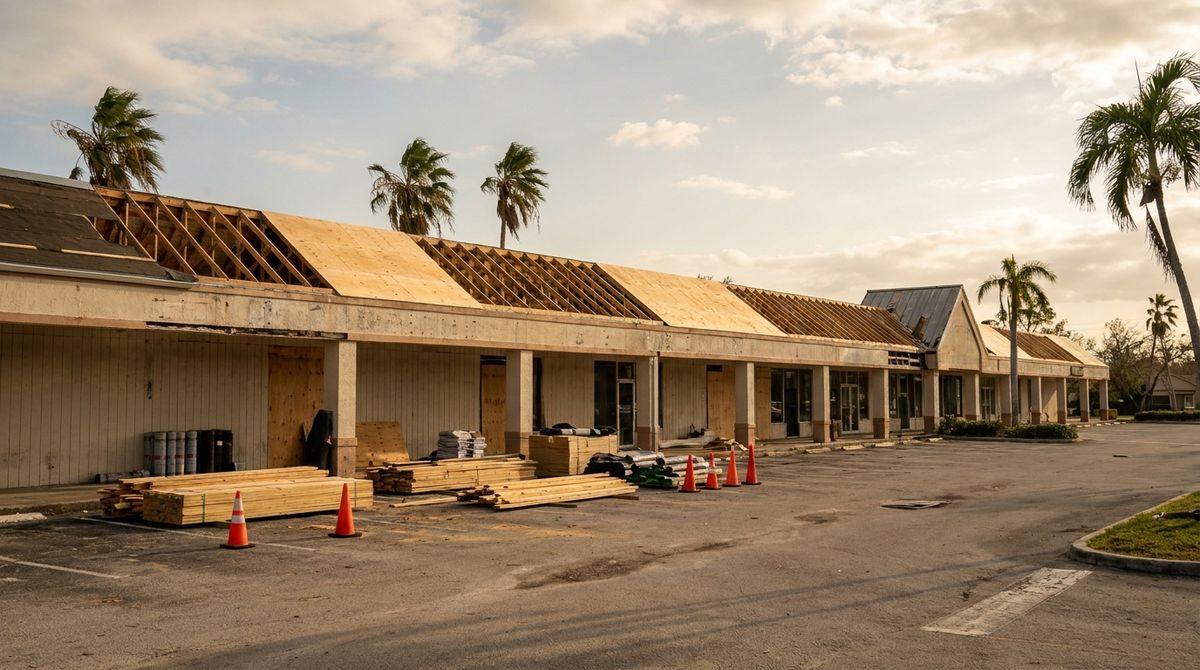
Open the Sarasota County Property Appraiser's card on a strip center and there is a number on it that looks official. Plenty of owners, and plenty of renewal worksheets, carry that number straight onto the property schedule as the building limit. It is the wrong number, and the commercial property form has a clause that charges the owner for using it on every claim, not only the total loss.
The county is not measuring what it costs to rebuild a plaza. By its own description, the Sarasota appraiser values commercial property mainly on income. The insurance policy, meanwhile, settles on what it costs to put the building back. Those are two different questions, and the gap between the answers is where coinsurance lives.
What the county number actually measures
Florida Statute 193.011 tells the property appraiser what to weigh in arriving at just value: present cash value, use, location, size, cost, condition, income, and the net proceeds of a sale after the usual costs of selling. It is a market value test. What would a willing buyer pay for this property, land and all.
The Sarasota County Property Appraiser says it sets just value with statistical mass appraisal using three approaches: comparable sales for most residential, cost for new construction, and income for multi-family, commercial and industrial property. So the number on a plaza's card is mostly a capitalized rent roll, set by a model that covers the whole county.
That number is wrong for insurance in at least three ways.
1. It includes the land. Nobody insures dirt. On a well-located Sarasota parcel the land can be a large share of market value, and none of it burns. 2. It reflects rent, not construction. A 1980s center with below-market leases can have a modest income value and still cost the full current price per square foot to rebuild after a fire or a storm. Income and replacement cost move independently. 3. The assessed value lags on purpose. Under Florida Statute 193.1555, the assessed value of nonresidential property cannot rise more than 10 percent a year, except after a sale or improvements. The taxable number on the bill can sit well below even the county's own just value for years.
None of that is a criticism of the appraiser. The office is answering a tax question. It was never asked what a roofer, a framing crew and a permit desk will charge after a hurricane.
How coinsurance turns a small gap into a big check
Most commercial property in this market is written on the standard ISO Building and Personal Property Coverage Form, CP 00 10. It carries a coinsurance condition, usually 80 or 90 percent. The insurer compares the limit you carried to the limit you should have carried, which is the coinsurance percentage times the building's value at the time of the loss. If you came up short, the claim is cut by the same ratio. The industry shorthand is "did over should," and PropertyCasualty360 walks through the formula in detail.
Here is the arithmetic, with round numbers to show the mechanism. These are illustration figures, not a client file.
- Replacement cost of the building: 8,000,000 dollars
- Coinsurance: 90 percent, so the required limit is 7,200,000 dollars
- Limit carried, lifted from a tax figure: 4,000,000 dollars
- Loss: wind takes the roof over four bays, 1,000,000 dollars of damage
The carrier pays 4,000,000 divided by 7,200,000, which is about 55.6 percent of the loss. That is roughly 555,600 dollars, less the deductible. The owner carries about 444,400 dollars of a covered claim personally, plus the deductible, on a loss that was a fraction of the limit.
That is the part owners miss. The limit looks like plenty for a roof claim. It is. But coinsurance does not ask whether the limit covers the loss. It asks whether the limit was honest about the building.
Why it hurts more on the Gulf Coast
Coinsurance is measured at the time of the loss, not at the time you bought the policy. After a named storm, that timing works against the owner. Every damaged building in the county is competing for the same contractors and materials at once, and the value of the building is judged in that market.
There is also the code. A plaza built in the 1980s gets rebuilt to today's Florida Building Code, not the one it was permitted under. That extra cost is not in the base building limit at all. It sits in ordinance or law coverage, which is a separate part of the policy and a separate post.
And the wind deductible on a Florida plaza is usually a percentage of the insured value. Under-insuring lowers that deductible on paper, which is one reason a low limit can look like a good renewal. It is not a savings if the coinsurance penalty takes back several times the difference on the first claim.
What fixes it
A replacement cost valuation, not the tax card. Use a recognized commercial cost estimator or an appraisal done for insurance. It should price the building by construction class, square footage, roof type and local labor, with the land left out. Update it at renewal, and redo it after any major improvement.
Agreed value. CP 00 10 has an optional Agreed Value provision. When the owner submits a statement of values the carrier accepts, the coinsurance condition is suspended for that policy term. The Independent Insurance Agents of Louisiana explains how the option works. It costs a real valuation up front and saves the argument after a storm. Not every carrier will grant it on every Florida coastal risk, but it is worth asking for on every renewal.
Inflation guard. An automatic annual increase on the building limit keeps a good valuation from going stale between appraisals.
Read the statement of values yourself. Look at the building limit per building, not the total. A center with an outparcel or a second building can be right in total and wrong on the one that burns.
I managed shopping centers before I insured them, and the tax bill was an operating expense line, nothing more. It belongs in the budget. It does not belong on the property schedule.
The point
The number on the Sarasota tax card is a market value built from rents and land, not a rebuild cost. Put it on a commercial property schedule with a coinsurance clause and every claim gets cut, not only the total loss. Get a replacement cost valuation, ask for agreed value, and check the limit building by building before the next renewal.
Sources
- Florida Statute 193.011, just valuation factors (2025 Florida Statutes): leg.state.fl.us
- Florida Statute 193.1555, 10 percent assessment limit on nonresidential property (2025 Florida Statutes): leg.state.fl.us
- Sarasota County Property Appraiser, how just value is determined (current office description): sarasotapropertyappraiser.gov
- Coinsurance penalty explained, ISO commercial property formula (PropertyCasualty360, 2013): propertycasualty360.com
- TA 313, Agreed Value Option in Commercial Property (IIABL technical affairs): iiabl.com
- More on Gulf Coast plaza coverage: Strip center and shopping center insurance
Get a quote on this coverage.
Ten minutes on the application. Dennis reads it himself and responds the same business day in most cases.
Start the application →Hendrickson Insurance, (941) 952-7991, dennis@hendricksonins.com, FL License E095547.
Coverage descriptions are general. Actual coverage is governed by the terms, conditions, and exclusions of the issued policy. Availability varies by carrier and by state.