
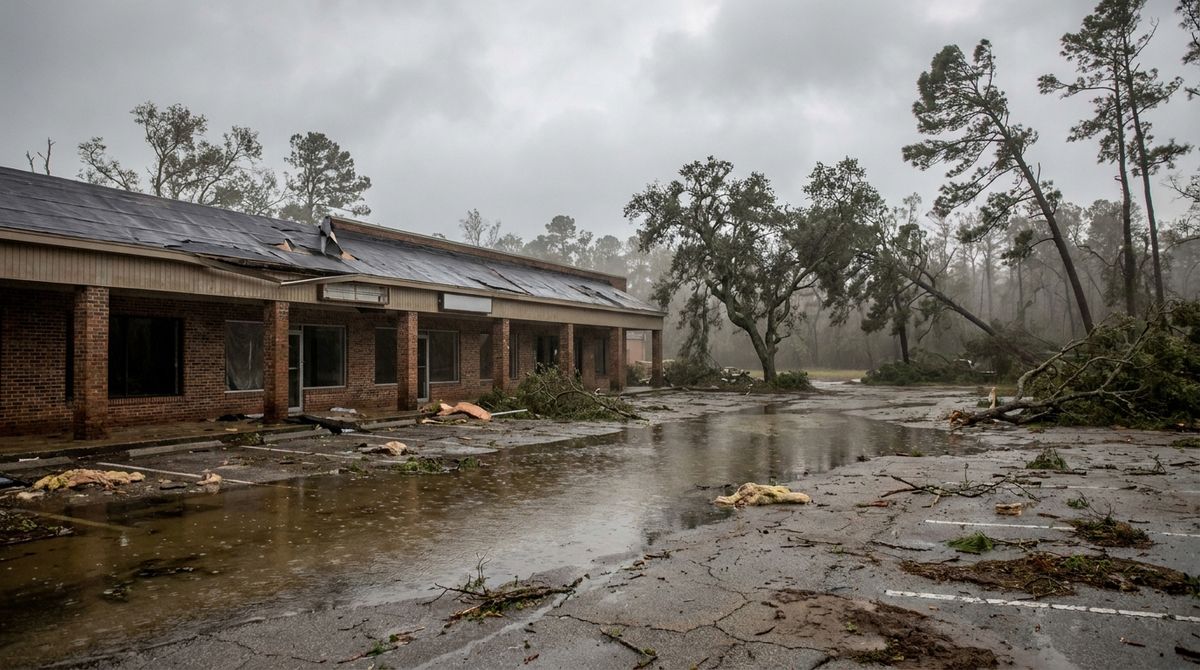
Hurricane Florence crossed Wrightsville Beach at 7:15 in the morning on September 14, 2018, as a Category 1. By the wind number it was a modest storm. Then it sat over eastern North Carolina for two days, and the National Weather Service in Wilmington recorded 35.93 inches of rain at Elizabethtown, the North Carolina record for a tropical cyclone. The damage that followed was mostly water, not wind.
A shopping center in New Hanover County does not have one policy for a storm like that. It has three, written by three different entities, with three deductibles and usually three adjusters. Every one of them did its job in Florence. The owners who got hurt were the ones whose three policies did not meet in the middle.
Why a Wilmington plaza needs three policies
North Carolina General Statute 58-45-5 draws two lines on the map. The beach area is everything south and east of the Intracoastal Waterway from the South Carolina line to Beaufort Inlet, then the Outer Banks up to Virginia. The coastal area is 18 counties: Beaufort, Brunswick, Camden, Carteret, Chowan, Craven, Currituck, Dare, Hyde, Jones, New Hanover, Onslow, Pamlico, Pasquotank, Pender, Perquimans, Tyrrell and Washington.
In those 18 counties, most commercial carriers will write a plaza's fire, theft, liability and everything else, but they exclude wind and hail. Wind goes to the North Carolina Insurance Underwriting Association, called the Beach Plan or the Coastal Property Insurance Pool. Per the association's own coverage page, it writes commercial windstorm and hail in both the beach and coastal territories, and commercial fire only in the beach territory. Its commercial building limit is 4 million dollars per building, capped at a 10 million dollar aggregate depending on the fire wall divisions of the structure. Contents are written at actual cash value only.
Flood is excluded on both of those. That is the third policy, almost always the NFIP. A commercial NFIP policy tops out at 500,000 dollars on the building and 500,000 dollars on contents.
So a typical Wilmington plaza looks like this:
1. A wind-excluded property policy from an admitted or surplus lines carrier, for fire and everything except wind, hail and flood. 2. A Beach Plan policy for wind and hail only. 3. An NFIP policy for flood.
Where Florence found the seams
The cause of loss fight. When a roof peels and rain comes through the deck, that is wind damage and the Beach Plan pays it. When the creek behind the center rises and comes through the front doors, that is flood and the NFIP pays it. When both happen in the same building in the same 48 hours, each adjuster is paid to measure only their part. Drywall that was wet from above and from below gets argued about. An owner with three agents, or one agent who never put the three files side by side, is the one standing in the middle of that argument.
Three deductibles on one storm. The Beach Plan wind policy carries its own deductible, often a percentage of the building value. The NFIP has its own. If the main policy picks up anything, there is a third. On a 4 million dollar building with a 5 percent wind deductible, the owner holds 200,000 dollars before the Beach Plan pays, and the flood deductible stacks on top if the water came in too. That is real money that belongs in the reserve fund, not a surprise in October.
The building worth more than the caps. The Beach Plan stops at 4 million per building. The NFIP stops at 500,000. A neighborhood center on Oleander Drive or Market Street with a 9 million dollar replacement cost and two buildings fits under the Beach Plan aggregate if the fire walls cooperate. It does not fit under the NFIP. Everything above 500,000 dollars of flood damage is uninsured unless there is an excess flood policy on top. Excess flood is where private carriers and Lloyd's belong, sitting above the NFIP, not replacing it.
Contents at actual cash value. Both the Beach Plan and NFIP commercial contents pay depreciated value. For a landlord that is usually small: the office, the maintenance shop, the common area furniture. For an owner-occupant running their own store in an end cap, it is the inventory and the fixtures, and the depreciation is the difference between reopening and not.
Loss of rents. Florence cut Wilmington off by road for days. Tenants could not open, and a lease with a casualty abatement clause stops the rent when the space is untenantable. The NFIP does not pay a landlord's lost rents at all. So the question for every plaza is which of the other two policies carries business income or rental value, for which cause of loss, and for how long. If the rents coverage sits only on the wind-excluded policy, it does not respond to a wind loss. Check each declarations page for it. Do not assume.
What I check on a coastal North Carolina plaza
I managed shopping centers before I placed insurance on them, so I read these the way an owner reads a rent roll: what pays, when, and who is holding the gap.
- The wind exclusion on the main policy and the Beach Plan policy describe the same buildings, the same values and the same effective dates. A gap of a day between renewals is a gap.
- The NFIP policy is in force before June. The NFIP has a 30-day waiting period for new policies, so buying flood when a storm is already in the Gulf Stream does not work.
- Building values are rebuilding cost, not the tax card. The Beach Plan limit and the NFIP limit are both ceilings, and an under-valued building hits them sooner.
- Excess flood above 500,000 dollars if the building is worth it, and before the lender asks.
- Loss of rents is on a policy that responds to wind and, where available, to flood, with a period long enough to rebuild under today's code and permitting backlog.
- The lender's insurance covenant matches all three. A mortgage that requires a named storm deductible under a set percentage will not accept a Beach Plan deductible above it.
The point
A Wilmington plaza's hurricane coverage is three policies that have to be read as one. The owners who came through Florence clean had one person who knew where each policy stopped and the next began. If yours are spread across three agents who have never compared notes, that is the gap to close this winter.
Get a quote on this coverage.
Ten minutes on the application. Dennis reads it himself and responds the same business day in most cases.
Start the application →Hendrickson Insurance, (941) 952-7991, dennis@hendricksonins.com, FL License E095547.
Coverage descriptions are general. Actual coverage is governed by the terms, conditions, and exclusions of the issued policy. Availability varies by carrier and by state.