
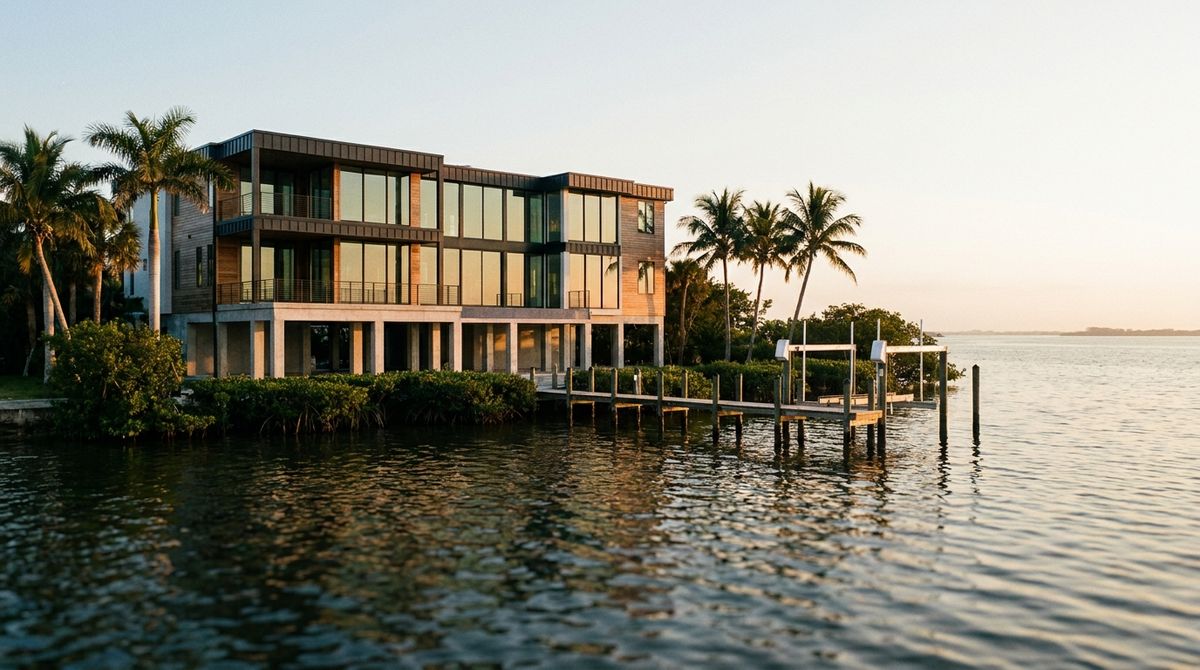
Most people on the Gulf Coast believe the same thing about Florida home insurance: if the private market says no, Citizens catches you. For an average house that is roughly true. For a three million dollar bayfront house on Longboat Key it is not true at all, and the owners who find that out in October are the ones who did not ask in June.
Citizens will not write that house. Not the multiperil policy, not the wind-only policy. The number that closes the door is 700,000.
The 700,000 wall
Citizens is a creature of statute, and the statute tells it who it may insure. Outside Miami-Dade and Monroe counties, a risk with a dwelling replacement cost of 700,000 dollars or more is not eligible for Citizens coverage. In Miami-Dade and Monroe the line is one million. Sarasota and Manatee counties, which is where Longboat Key sits, get the 700,000 line.
That ceiling is not only on the full homeowners policy. Citizens wind-only coverage in the coastal high-risk account carries the same limit: Coverage A under 700,000, under one million in Miami-Dade and Monroe. So the barrier island house cannot buy just the wind piece from Citizens either.
There is a second rule people quote more often and understand less. Citizens may write you only if no authorized Florida carrier will cover the home, or if the private offer is more than 20 percent higher than comparable Citizens coverage. If an admitted carrier comes in within 20 percent, you are ineligible, at new business and at renewal both. That rule is what pushes ordinary houses back out of Citizens. On Longboat Key at three million, the replacement cost rule got there first.
So when a private-client carrier declines a high-value home in Sarasota County, the fallback is not Citizens. It is surplus lines. Different pricing, different forms, different rules about what the policy actually promises. Worth knowing before you need it.
What Chubb, PURE and Vault are underwriting
Private-client carriers are not reading the same file a standard Florida homeowners carrier reads. They want the whole household, and they underwrite five things.
Replacement cost, not market value. The first thing that kills a private-client submission is a Coverage A number pulled off the tax roll or the last sale price. These carriers set Coverage A on a real replacement cost estimate for the actual construction: the impact glass, the elevation, the pilings, the millwork, the finishes. On the bay side that number is often well above what the house would bring as a teardown lot, and well above what the owner expected. That is the point of the policy. Guaranteed or extended replacement cost is worth nothing if Coverage A was set at a number that will not rebuild the house.
The roof. Age, material, attachment, and whether it has been through a named storm. Florida law protects an owner here more than most know. An insurer may not refuse to issue or renew solely because of roof age when the roof is less than 15 years old, and for a roof 15 or older the insurer has to let you produce an inspection first. If that inspection shows at least five years of useful life remaining, roof age by itself is not a decline. Order it before the underwriter orders theirs.
Wind mitigation. Florida requires insurers to discount for approved wind resistant construction, and on a coastal high-value home those credits are the difference between a quote and a decline. Roof covering, roof deck attachment, roof to wall connection, roof geometry, secondary water resistance, opening protection. Get the report done, fix the cheapest failing item, get it re-done. At this value the premium swing pays for the work quickly.
Water. The most expensive thing that happens to a Sarasota high-value home in an ordinary year is not the storm. It is a supply line, a water heater, or a failed valve in a house that sits empty half the year. Private-client carriers credit automatic water shutoff and leak detection, and above certain values some of them effectively require it. If the house is seasonal, expect questions about who checks it and how often.
The rest of the household. This is what standard-market thinking misses. Chubb, PURE and Vault want the autos, the umbrella, the boat, the collections and the second property on the same account. A monoline high-value home submission with nothing attached to it is the one that gets passed over in a hard coastal market. A full account is the one that gets written.
The flood layer is separate, and it is not optional
All of Florida is a flood zone. The only question is whether it is a hazardous one. On Longboat Key it is.
The NFIP maximum on a single family home is 250,000 dollars on the building and 100,000 on contents. That is the floor, not the policy. A three million dollar house needs excess flood stacked above the NFIP layer up to full replacement cost, and that layer comes from the private-client carrier or the excess market.
I keep NFIP primary and put private flood on top of it. Private flood carriers write the house and then non-renew it after the claim. The NFIP does not non-renew. Excess is the right job for private flood. Primary is not.
Citizens has been moving the same direction by statute. Its flood requirement phased in by dwelling value: 600,000 and up in 2024, 500,000 and up in 2025, 400,000 and up as of January 1, 2026, and all Citizens personal residential policies by 2027, regardless of flood zone. The state's own insurer of last resort now treats flood as part of the package. A private-client household should have been treating it that way already.
What actually sends a house to surplus lines
Not the value. The value alone is what private-client carriers are built for. What sends it out is a roof past its useful life, an open claim, an unrepaired prior loss, a long vacancy with nothing monitoring it, a polybutylene or aluminum wiring situation nobody disclosed, or an account that is one house and nothing else in a year when the carrier is managing coastal capacity.
Most of those are fixable. Almost all of them are fixable in the ninety days before renewal rather than the two weeks after the non-renewal letter.
The point
At three million on Longboat Key the placement is private client or it is surplus lines, and which one you get is decided by the roof file, the wind mitigation report, the replacement cost number, and whether the rest of the household is on the account. Start ninety days out, not two weeks out. And if you own a building or a business on the other side of your balance sheet, put both sides with one agent so nobody has to guess where the coverage stops.
Get a quote on this coverage.
Ten minutes on the application. Dennis reads it himself and responds the same business day in most cases.
Start the application →Hendrickson Insurance, (941) 957-2796, dennis@hendricksonins.com, FL License E095547.
Coverage descriptions are general. Actual coverage is governed by the terms, conditions, and exclusions of the issued policy. Availability varies by carrier and by state.
Sources
- Section 627.351(6), Florida Statutes, Citizens eligibility and flood requirement phase-in (2025): www.flsenate.gov
- Section 627.7011, Florida Statutes, roof age and inspection rule (2025): www.flsenate.gov
