
Plenty of Sarasota and Gulf Coast Florida business owners carry two umbrella insurance policies and believe that makes them covered twice. One is a personal umbrella over the home and the cars. The other is a commercial umbrella over the business. Usually two different agents wrote them, and those two agents have never spoken.
Two umbrellas do not stack into one big one. Each is written for a different insured, sits over a different list of underlying policies, and excludes the other side's world on purpose. The gap lives in the seam between them, and a shopping center owner is one of the people most likely to fall into it.
This is not about one client. It is how the forms are built, walked through with the kind of claim a plaza produces.
The setup
Take an ordinary Gulf Coast arrangement. The plaza is titled to an LLC. The commercial agent writes the LLC a property policy, a general liability policy, and a commercial umbrella that lists the general liability as its underlying. The LLC owns no vehicles, so nobody quoted commercial auto.
The owner's personal agent writes the house, two cars, and a personal umbrella over the auto and homeowners policies.
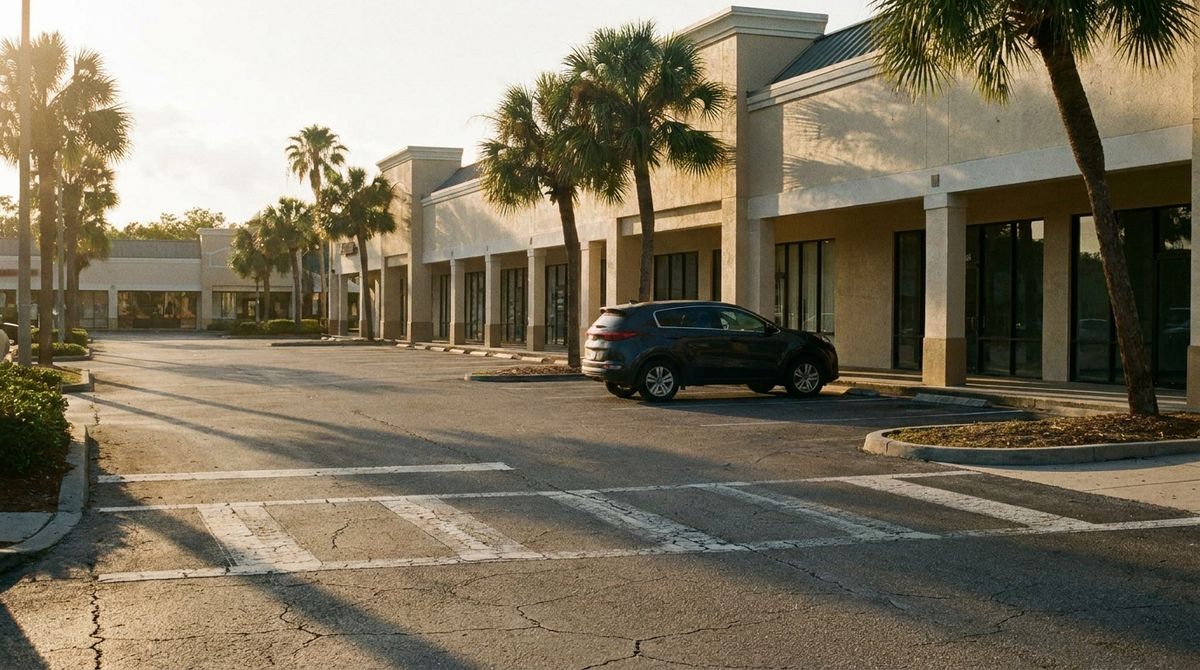
On paper that is three liability policies and two umbrellas. Now the owner drives the family SUV to the plaza on a Tuesday to meet a roofer, backs out of a space, and hits a shopper walking behind the car.
Who gets sued
The shopper's lawyer sues the owner as the driver. The lawyer also sues the LLC, because the owner was there doing the LLC's business, and an entity can be held responsible for someone driving on its behalf. The LLC is the defendant with the plaza behind it.
Now look at each policy in turn.
The personal auto answers for the owner as driver, up to its limits. That part usually works.
The LLC's general liability does not answer. The standard commercial general liability form excludes bodily injury arising out of the use of an auto. That exclusion is a pillar of the form, not fine print.
The commercial umbrella follows the underlying it was sold over. It was scheduled over general liability only. Most commercial umbrellas carry a condition that the listed underlying insurance must be maintained, and an auto exposure with no auto policy under it is either excluded outright or handled as if the insured were carrying that first layer themselves. Either way, the LLC is paying the first layer out of the plaza's cash.
The personal umbrella was written for a household. Most personal umbrella forms exclude business pursuits and business property, and the named insured is a person, not the LLC. Some forms carve personal autos back in even on a business errand, and some do not. Whether it helps the owner turns on the exact wording, and it will not defend the LLC under any version I have read.
So the LLC, the defendant with the most money behind it, has no auto coverage at all.
The fix that costs almost nothing
The endorsement that closes that hole is hired and non-owned auto liability. It covers the business when an employee or owner drives a car the business does not own on business errands. It is one of the cheapest coverages in commercial insurance, often added to the general liability or a package policy. Then the commercial umbrella gets scheduled over it, so the upper layer has something to sit on.
That is the whole fix for this claim. One endorsement and one line on the umbrella schedule. It was not done because the commercial agent never asked how the owner gets to the property, and the personal agent never asked what the owner owns.
The sentence that splits the owner in two
There is a second seam, and it is written into the commercial liability form itself.
The standard commercial general liability form says that if the named insured is a limited liability company, the members are also insureds, "but only with respect to the conduct of your business." Commercial umbrellas generally follow that language.
Read it from the owner's side. When the owner is doing the plaza's business, the LLC's policies protect the owner. When the owner is not, they do not, and the personal umbrella is supposed to pick it up. But the personal umbrella excludes business pursuits.
Most days that line is clean. The claims that hurt are the ones where it is not. The owner lets a friend's son use the plaza's empty bay for a weekend event. The owner walks a prospective tenant through the space on a Sunday and brings the dog. The owner's spouse, who is not a member, is at the property collecting rent checks. Each carrier reads the facts toward the other policy, and while they argue, somebody still has to pay defense counsel.
When one agent writes both sides, that argument gets settled when the policies are designed, not after the lawsuit arrives. The same person reads both forms and makes the edges touch.
The underlying limits trap
The third gap is quieter. Every umbrella has a minimum it expects underneath it. A personal umbrella commonly requires personal auto liability at 250,000 per person and 500,000 per accident, or a 500,000 combined single limit, and a set minimum on the homeowners liability. A commercial umbrella lists its own required underlying limits on its schedule.
If the auto is carrying 100,000 and 300,000 because that is what it had when the owner was 30, the personal umbrella does not drop down to fill the difference. It pays as if the required limit were there. The owner pays the gap out of pocket.
The same thing happens on the commercial side when a general liability renewal gets rewritten at a lower limit to save premium and nobody updates the umbrella. Two agents means two renewal dates, two sets of paperwork, and nobody whose job it is to check that layer one still matches layer two.
What I check on a plaza owner
I managed shopping centers before I sold insurance. The owners I worked with did not separate their lives the way their insurance did. They drove their own cars to the property. Their family members helped. Some held a second building in their own name and the plaza in an LLC. That is normal, and it is why I start every plaza owner with both sides on the table.
The review is short:
1. Every entity and every property, and whose name each one is titled in. 2. Who drives to the properties, in what vehicles, and whether the business has hired and non-owned auto. 3. The underlying schedule on both umbrellas against the actual limits on the policies beneath them. 4. The business exclusion in the personal umbrella and the insured definitions in the commercial forms, read side by side. 5. Whether the commercial umbrella and the personal umbrella together reach a limit that matches the net worth a plaintiff can see.
None of that is exotic. It just requires one person looking at both halves of the balance sheet.
The point
A plaza owner with a personal umbrella and a commercial umbrella can still be bare for an ordinary parking lot accident, because each policy was designed to exclude the other side's world. The fix is usually one endorsement, one schedule update, and one agent who reads both. If you own a shopping center on the Gulf Coast and your home and your plaza are with different agents, put both sets of forms in front of one person before the next renewal.
Get a quote on this coverage.
Ten minutes on the application. Dennis reads it himself and responds the same business day in most cases.
Start the application →Hendrickson Insurance, (941) 952-7991, dennis@hendricksonins.com, FL License E095547.
Coverage descriptions are general. Actual coverage is governed by the terms, conditions, and exclusions of the issued policy. Availability varies by carrier and by state.